

Saved Bookmarks
| 1. |
i) An organic compound, C_(4)H_(6), on ozonolysis gives formaldehyde and glycol. What is this compound? ii) C_(4)H_(6) can represent various structures, Identify: a) Which reacts with ammoniacal AgNO_(3), b) Which does not react with ammoniacal AgNO_(3) but by hot aklkaline KMnO_(4) gives CH_(3)COOH, c) Which decolourises Br_(2) water and by catalyst hydrogenation (using 1 mol) and subsequent reaction with alkaline KMnO_(4) gives CH_(3)COOH and d) Which by ozonolysis using O_(3)//H_(2)O gives succinic acid. |
|
Answer» SOLUTION :i) The formula suggests that either the compound is an alkyne or an alkadiene. The products of ozonolysis SUGGEST that the compound is alkadiene. It may have the FOLLOWING structures. `H_(2)C=CH-CH=CH_(2)`(A) (Buta-1.3-diene) `CH_(3)-CH=C=CH_(2)`(Buta-1,2-diene) (B) FORMALDEHYDE and glyocol can be obtained from (A). Hence, the compound is buta,1,3-diene. ii) a) `C_(4)H_(6)` reacts with ammonicial `AgNO_(3)`, so it is a terminal alkyne `(-C-=C-H)`. For EXMAPLE, `CH_(3)CH_(2)-C-=CH`(But-1-yne) b) `C_(4)H_(6) overset(KMnO_(4) alk)underset(Delta)to(CH_(3)COOH` Hence, it is `CH_(3)-C-=CH_(3)` (But-2-yne) 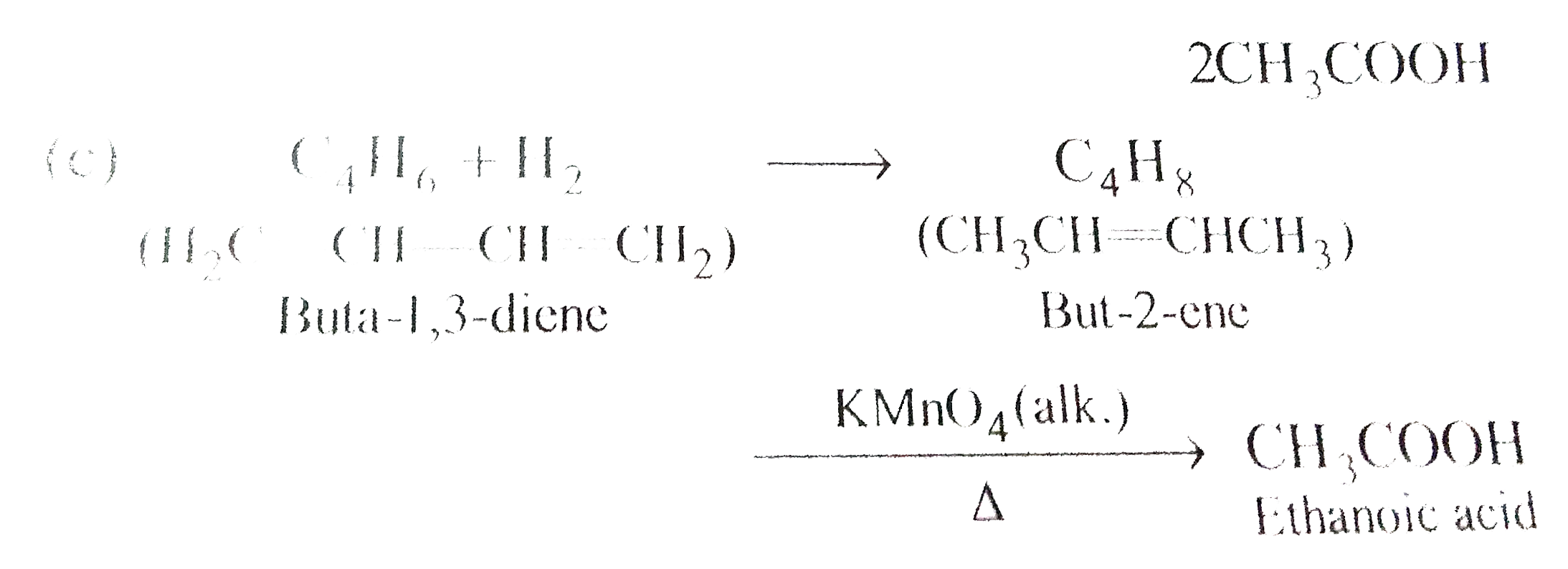 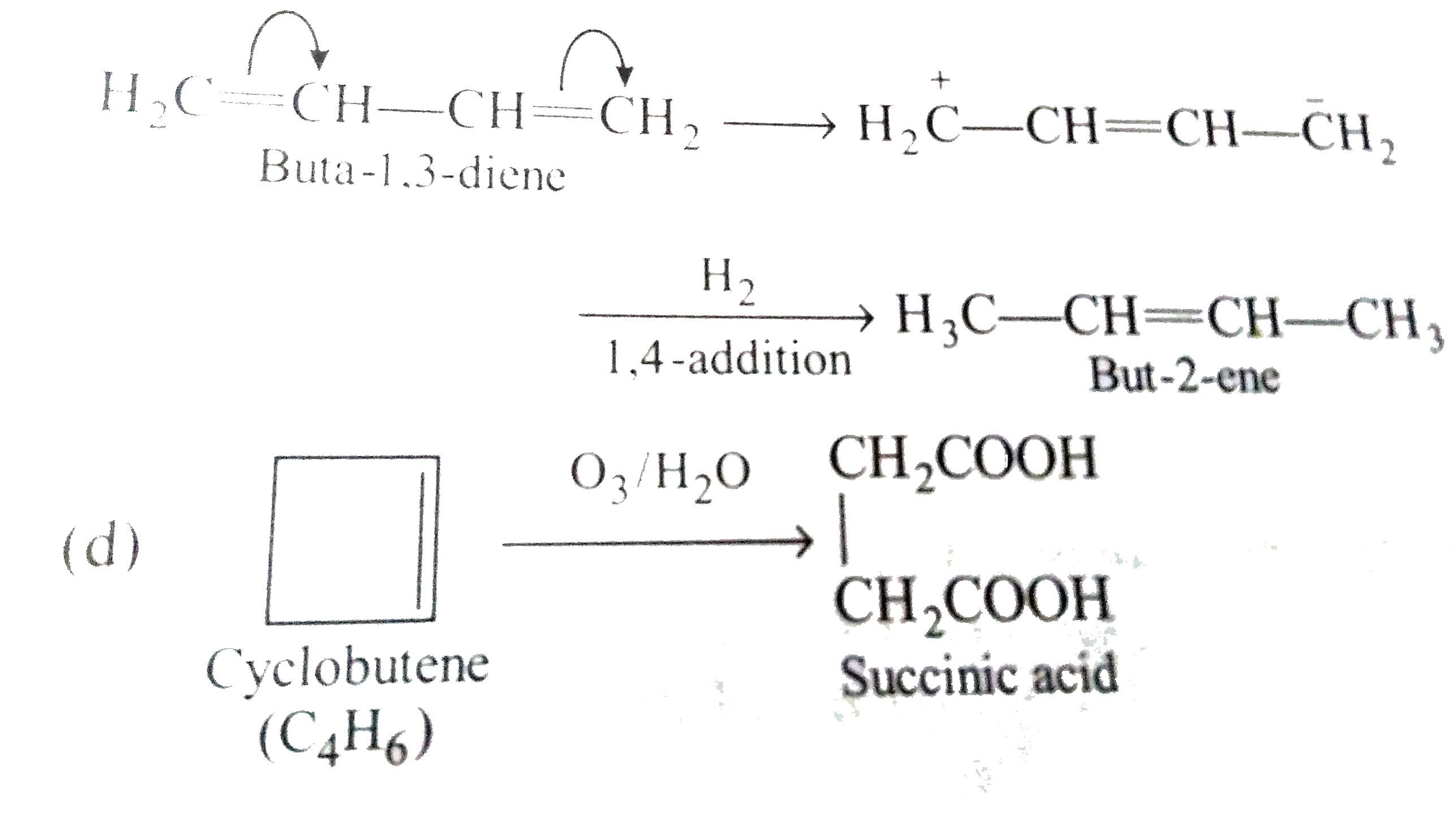
|
|