

Saved Bookmarks
| 1. |
(i) Explain about the hydrolysis of salt of strong base and weak acid. Derive the value of K_(h) for that reaction. (ii) Identify the Lewis acid and the Lewis base in the following reactions. (1) CaO + CO_(2) rarr CaCO_(3) (2) |
|
Answer» Solution :(i) 1. Coordination number : The number of nearest neighbours that surrounding a particle in a crystal is called the coordination number of that particle. 2. In aqueous solution, `CH_(3)COONa` is completely dissociated as follows. `CH_(3) COONa_((aq)) rarr CH_(3)COO_((aq))^(-) + Na_((aq))^(+)` 3. `CH_(3)COO^(-)` is a conjugate base of the weak acid `CH_(3)COOH` and it has a tendency to react with `H^(+)` from water to produce unionised acid. But there is no such tendency for `Na^(+)` to react with `OH^(-)` 4. `CH_(3) COO_((aq))^(-) + H_(2)O_((l)) harr CH_(3) COOH_((aq)) + OH_((aq))^(-)` and therefore `[OH^(-)] gt [H^(+)]`, in such cases, the solution is basic due to the HYDROLYSIS and pH is greater than 7. 5. Relationship between equilibrium CONSTANT, hydrolysis constant and the dissociation constant of acid is derived as follows : `K_(h) = ([CH_(3)COOH][OH^(-)])/([CH_(3)COO^(-)][H_(2)O])` `K_(h) = ([CH_(3)COOH][OH^(-)])/([CH_(3)COO^(-)])""...(1)` `CH_(3)COOH_((aq)) harr CH_(3) COO_((aq))^(-) + H_((aq))^(+)` `K_(h) = ([CH_(3)COO^(-)][H^(+)])/([CH_(3)COOH])""...(2)` Equation `(1) xx (2)` `K_(h) .K_(a) = [H^(+)] [OH^(-)]` `[H^(+)] [OH^(-)] = K_(w)` `therefore""K_(h) . K_(a) = K_(w)` `K_(h)` valuein terms of degree of hydrolysis (h) and the concentration of salt (c) for the equilibrium can be obtained as in the case of Ostwald.s dilution law `K_(h) = h^(2) C and [OH^(-)] = sqrt(K_(h).c)`. (ii) 1. `CaO + CO_(2) rarr CaCO_(3)` (a) CaO - Lewis base , All metals oxides are Lewis bases (b) `CO_(2)`-Lewis acid , `CO_(2)` contains a polar DOUBLE bond. 2. 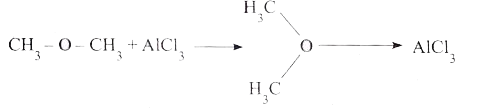 (a) `CH_(3) - O - CH_(3)`-Lewis base , Electron rich SPECIES (b) `AlCl_(3)`-Lewis acid , `AlCl_(3)` is electron deficient molecule. |
|