

Saved Bookmarks
| 1. |
(i) Explain the role of carbon monoxide in the purification of nickel? (ii) Describe the structure of diborane. |
|
Answer» SOLUTION :(i) During the purification of Nickel by Mond.s process, carbon monoxide (CO) is used to CONVERT impure nickel to nickel carbonyl. Nickel carbonyl is an unstable compound. Heating to higher temperature decomposes it to give pure nickel. (ii) In diborane two `BH_(2)` units are linked by two bridged hydrogens. Therefore, it has eight B-H bonds. However, diborane has only 12 valance electrons and are not sufficient to FORM normal covalent bonds. The four terminal B-H bonds are normal covalent bonds (two centre - two electron bond or 2c-2e bond). The remaining four electrons have to used for the bridged bonds. i.e. two three centred B-H-B bonds utilise two electrons each. HENCE, these bonds are three centre- two electron bonds. The bridging hydrogen atoms are in a plane as SHOWN in the figure. In diborne, the boron is `sp^(3)` hybridised. Three of the four `sp^(3)` hybridised orbitals contains single electron and the fourth orbital is empty. Two of the half filled hybridised orbitals of each boron overlap with the two hydrogens to form four terminal 2c-2e bonds, leaving one empty and one half filled hybridised orbitals on each boron. The three centre - two electron bonds, B-H-B bond formation involves overlapping the half filled hybridised orbital of one boron, the empty hybridised orbital of the other boron and the half filled 1 s orbital of hydrogen. 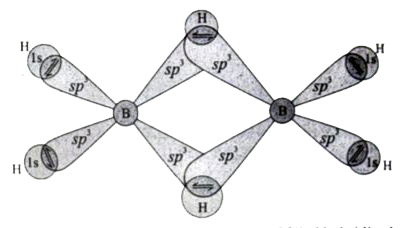
|
|