

Saved Bookmarks
| 1. |
(i) How would you calculate the solubility of sparingly soluble salt using Kohlrausch's law ? (ii) Formic acid act as reducing agent. Prove this statement. |
|
Answer» Solution :(i) Substances like `AgCl, PbSO_(4)` are sparingly soluble in water. The solubility product can be determined using conductivity experimentss. 2. Let us consier AgCl as an example `AgCl_((s)) harr Ag^(+) + Cl^(-)` `K_(SP) = [Ag^(+)] [Cl^(-)]` 3. Let the concentration of `[Ag^(+)]` be .C. mol `L^(-1)` If `[Ag^(+)]` = C, then `[Cl^(-)]` is also equal to C mol `L^(-1)` `therefore K_(sp) = C.C` `K_(sp) = C^(2)` 4. The relationship between molar CONDUCTANCE and equivalent conductance is `A_(@) = (K xx 10^(-3))/(C(mol L^(-1)))(or) C = (K xx 10^(-3))/(A^(@))` Substitute the concentration value in the relation `K_(sp) = C^(2)` `K_(sp) = [(K xx 10^(-3))/(A^(@))]^(2)` (ii) 1. FORMIC acid contains both an aldehyde as WELL as an acid group. Hence, like other aldehydes, formic acid can easily be oxidised and therefore acts as a strong reducing agent. 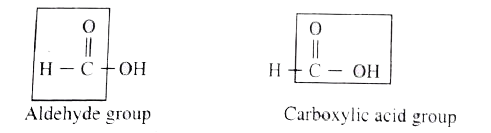 2. Formic acid reduces Tollen.s REAGENT (ammonical silver nitrate solution) to metallic silver. `HCOO^(-) + underset(("Tollen.s reagent"))(2 Ag^(+) + 3OH^(-)) rarr underset(("Silver mirror"))(2Ag + CO_(3)^(2-)) + 2H_(2)O` 3. Formic acid reduces Fehling.s solution. It reduces blue coloured cupric ions to red coloured cuprous ions. `HCOO^(-) + underset(("Blue"))underset(("Fehlings solution"))(2Cu^(2+) + 5OH^(-)) rarr underset("Red precipitate")(Cu_(2)O darr) + CO_(3)^(2-) + 3H_(2)O` |
|