

Saved Bookmarks
| 1. |
(i) State the principle of working of a meter bridge. (ii) In a meter bridge balance point is found at a distance I_(1) with resistances R and S as shown in the figure. When an unknown resistance X is connected in parallel with the resistance S, the balance point shifts to a distance I_(2). Find the expression for X in terms of l_(1), l_(2) and S. |
|
Answer» Solution :(i) A SLIDE wire BRIDGE is KNOWN as Metre bridge. It is constructed on the principle of balanced wheatstone bridge. When a Wheaststone bridge is balanced then, `P/Q=l/(100-l)` 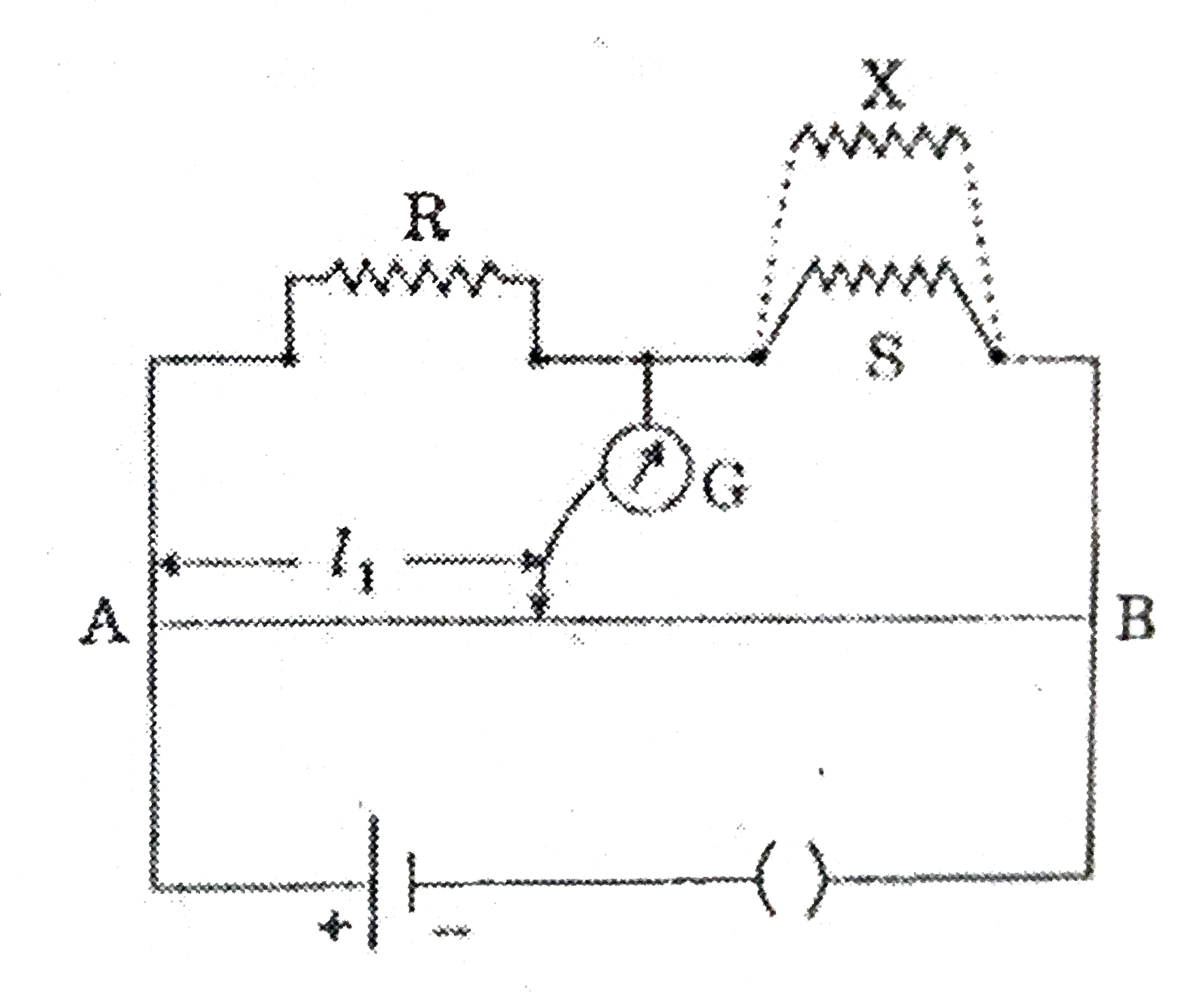 (ii) When resistace R and S are connected : Since, balance point is found at a distance `l_(1)` from the zero and `:. R/S=l_(1)/(100-l_(1))` ...(i) When unknown resistance X is connected in parallel to S. `:.` Total resistance in the right hand GAP is `S_(1)=(SX)/(S+X)""[ :] 1/R=1/R_(1)+1/R_(2) implies R=(R_(1)R_(2))/(R_(1)+R_(2))]` Since, balance point is obtained at a distance `l_(2)` from the zero end `:. R/S_(1)=l_(2)/(100-l_(2))` Putting the value of `S_(1)` we get `R/((SX)/(S+X))=l_(2)/(100-l_(2))` `(R(S+X))/(SX)=l_(2)/(100-l_(2))` ...(ii) Dividing (ii) by (i), we get `(R(S+X))/(SX).S/R=l_(2)/(100-l_(2))xx(100-l_(1))/l_(1)"",""(S+X)/X=(l_(2)(100-l_(1)))/(l_(1)(100-l_(2)))` `S/X+X/X= (l_(2)(100-l_(1)))/(l_(1)(100-l_(2)))""implies""S/X+1=(l_(2)(100-l_(1)))/(l_(1)(100-l_(2)))` `S/X+X/X=(l_(2)(100-l_(1)))/(l_(1)(100-l_(2)))""implies""S/X+1=(l_(2)(100-l_(1)))/(l_(1)(100-l_(2)))` `S/X=(l_(2)(100-l_(1)))/(l_(1)(100-l_(2)))-1` `=(100 l_(2)-l_(1)l_(2)-100 l_(1)+l_(1)l_(2))/(l_(1)(100-l_(2))),""S/X=(100(l_(2)-l_(1)))/(l_(1)(100-l_(2)))` Hence, `X=(l_(1)(100-l_(2)))/(100(l_(2)-l_(1))).S"":.""X=(100l_(1)s-l_(1)l_(2)s)/(100(l_(2)-l_(1)))` |
|