Saved Bookmarks
| 1. |
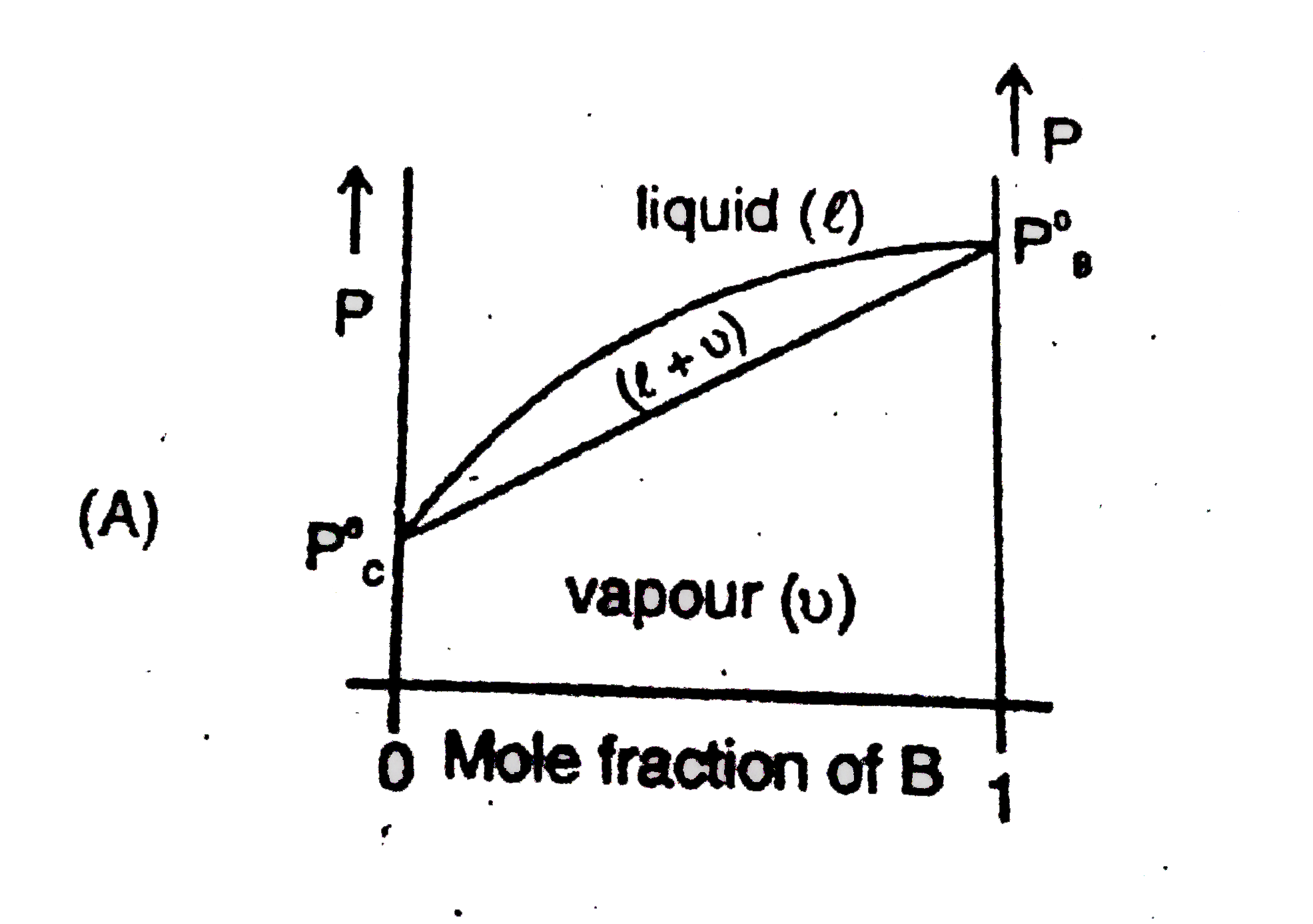
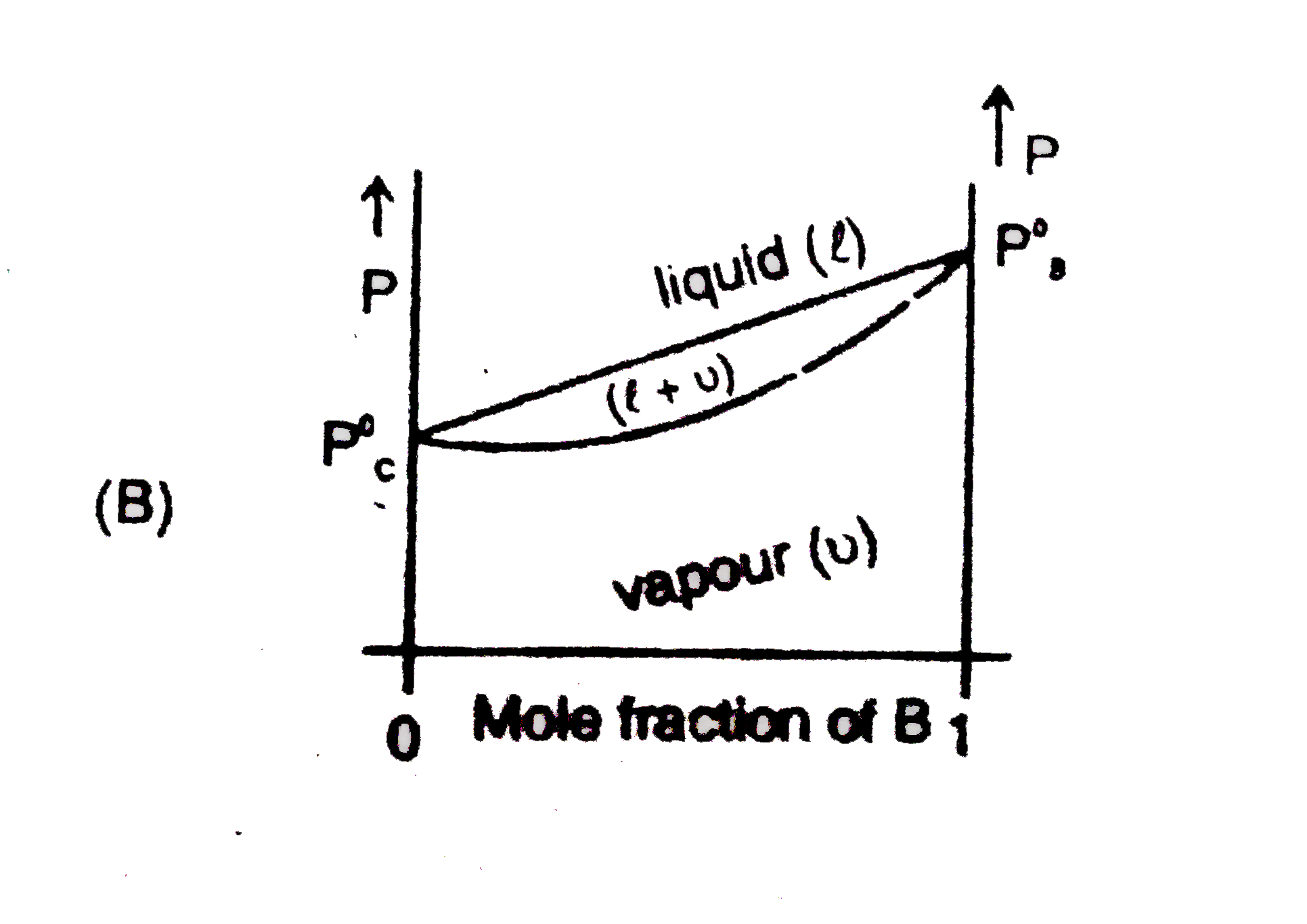
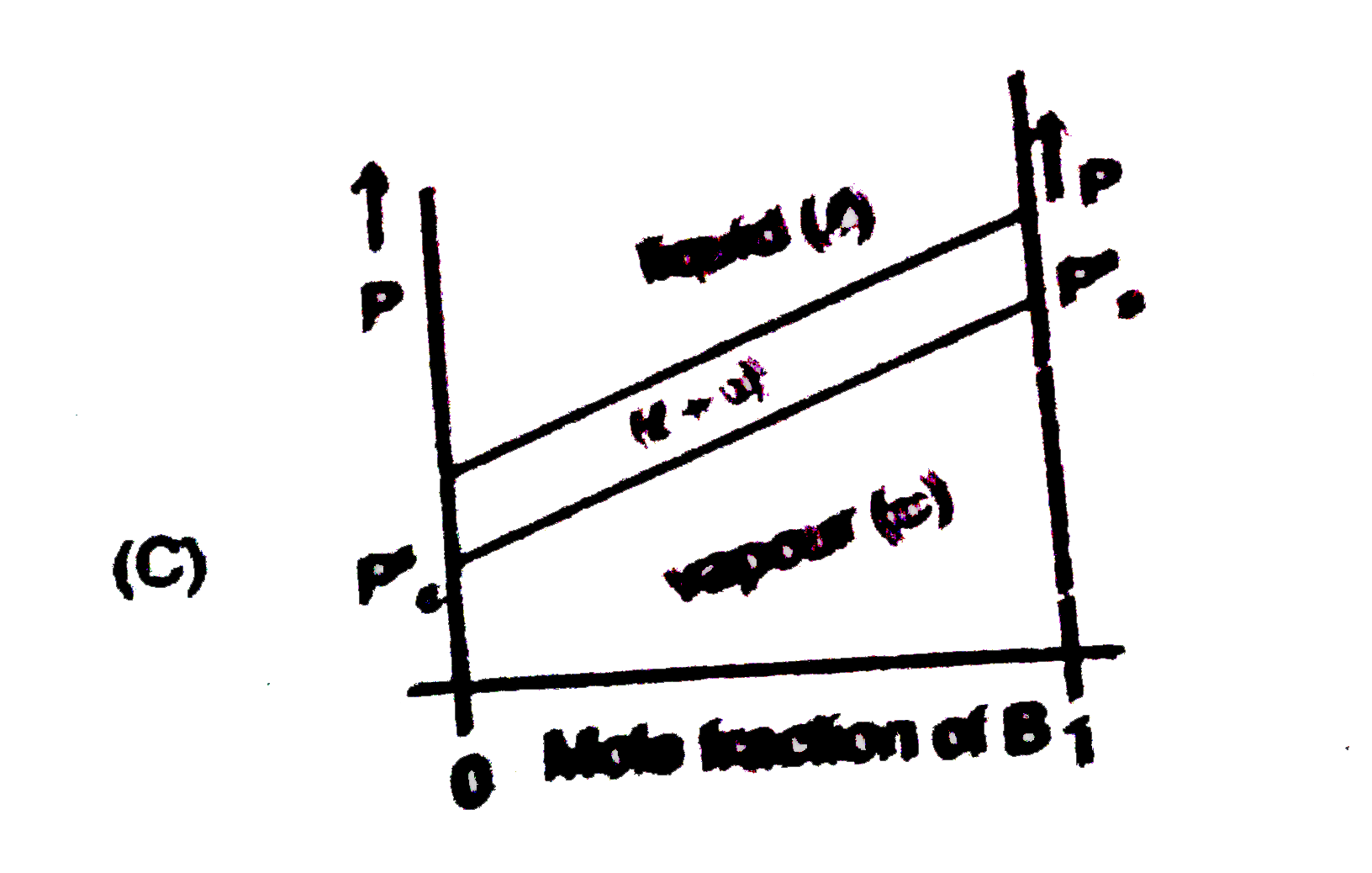
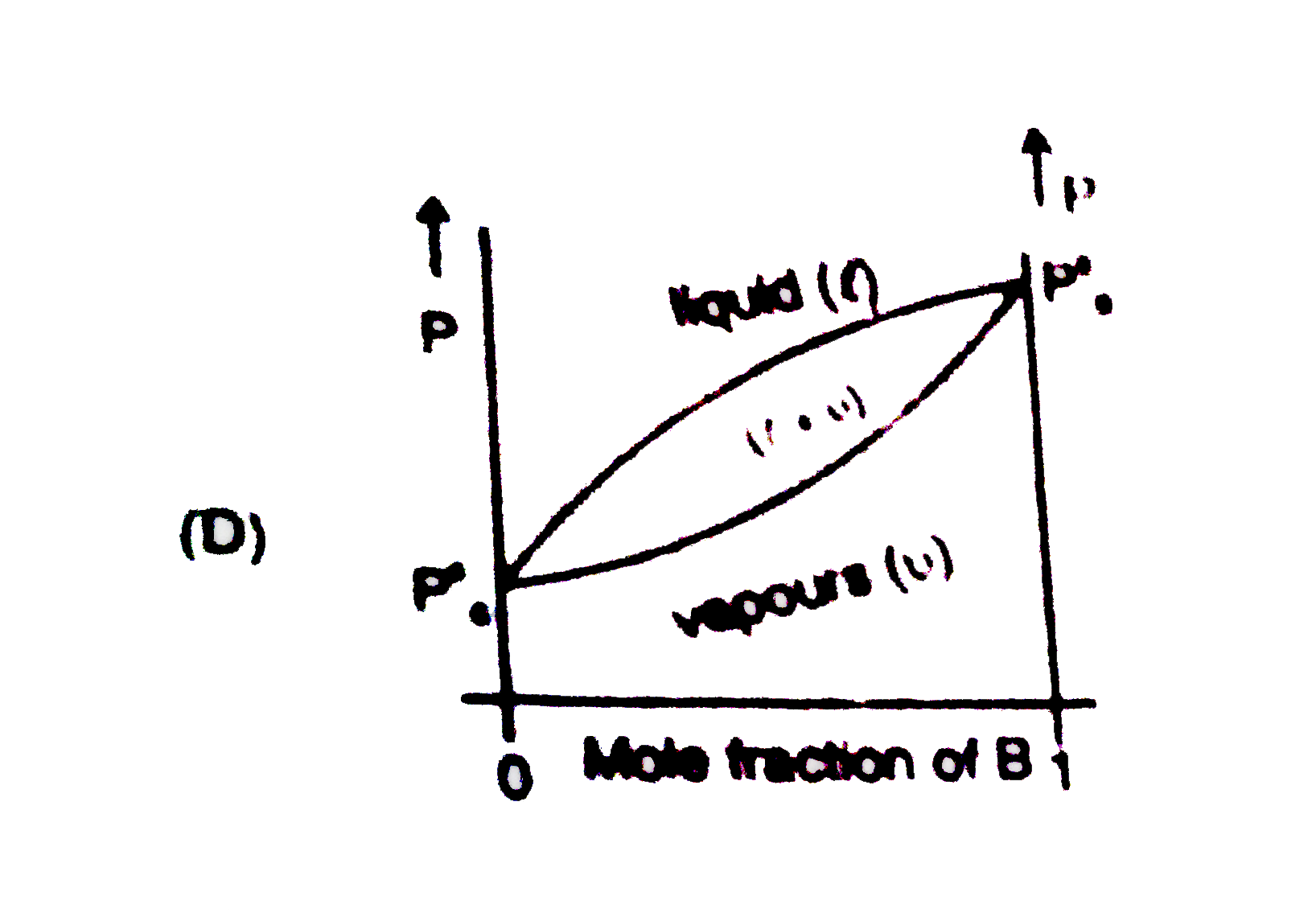
IDEAL SOLUTION AT FIXED TEMPERATURE Consider two liquids 'B' and 'C' that form an ideal solution. We hold the temperature fixed at some value T that is above the freezing points of 'B' and 'C' .We shall plot the system's pressure P against x_B,the overall mole fraction of B in the system : x_B=(n_(B,"total"))/n_("total")=(n_(B)^l+n_B^v)/(n_(B)^v+n_C^l+n_(C)^v+n_B^l) Where n_B^l and n_B^v are the number of moles of B in the liquid and vapour phases, respectively.For a closed system x_B is fixed, although n_B^l and n_B^vmay vary. Let the system be enclosed in a cylinder fitted with a piston and immersed in a constant-temperature bath. To see what the P-versus-x_B phase diagram looks like, let us initially set the external pressure on the piston high enough for the system to be entirely liquid (point A in figure) As the pressure is lowered below that at A, the system eventually reaches a pressure where the liquid just begins to vaporizes (point D).At point D, the liquid has composition x_B^l and x_B^l at D is equal to the overall mole fraction x_B since only an infinitesimal amount of liquid has vapourized. What is the composition of the first vapour that comes off ? Raoult's law, P_B=x_B^vP_B^0 related the vapour-phase mole fractions to the liquid composition as follows : x_B^v=(x_B^lP_B^0)/P and x_C^v=(x_C^lP_C^0)/P ...(1) Where P_b^0 and P_C^0 are the vapour pressure of pure 'B' and pure 'C' at T.where the system's pressure equals the sum P_B+P_C of the partial pressure, where x_B^l=n_B^l/((n_B^l+n_C^l)), and the vapor is assumed ideal. x_B^v/x_C^v=(x_B^lP_B^.)/(x_C^lP_C^.) ideal solution ...(2) Let B be the more volatile component, meaning that P_B^0gtP_C^(0).Above equation then shows that x_B^v//x_C^vgtx_B^l//x_C^l.The vapor above an ideal solution is richer than the the liquid in the more volatile component.Equations (1) and (2) apply at any pressure below point D.causing more liquid to vaporize.Eventually, we reach point F in figure.where the last drop of liquid vapourizes.Below, F we have only vapor.For any point on the line between D and F liquid and vapor coexist in equilibrium. If the above process is repeated for all other compositions of mixture of C and B.if all the points where vapours start converting into liquid are connected than obtained graph will look like. |
|
Answer»
`P=X_B^lP_B^@+X_C^lP_C^@` `=X_B^lP_B^@+(1-x_B^l)P_C^@` `=P_C^@+(P_B^@-P_C^@)X_B^l=P_C^@+(P_B^@-P_C^@)X_B` The second curve will not be a straight line having equation `P=(P_B^@-P_C^@)/(X_B^l(P_C^@-P_B^@)+P_B^@)` |
|