

Saved Bookmarks
| 1. |
In a photoelectric setup, a point source of light of power 3.2xx10^(-3) W emits monoenergetic photons of energy 5.0 eV. The source is located at a distance of 0.8 m from the center of a stationary metallic sphere of work function 3.0 eV and of radius 8.0xx10^(-3)m. The efficiency of photoelectron emission is 1 for every 10^(6) incident photons. Assume that the sphere is isolated and initially neutral and that photoelectrons are instantaneously swept away after emission. Q. Calculate the number of photoelectrons emiited per second . |
|
Answer» `10^(3)` 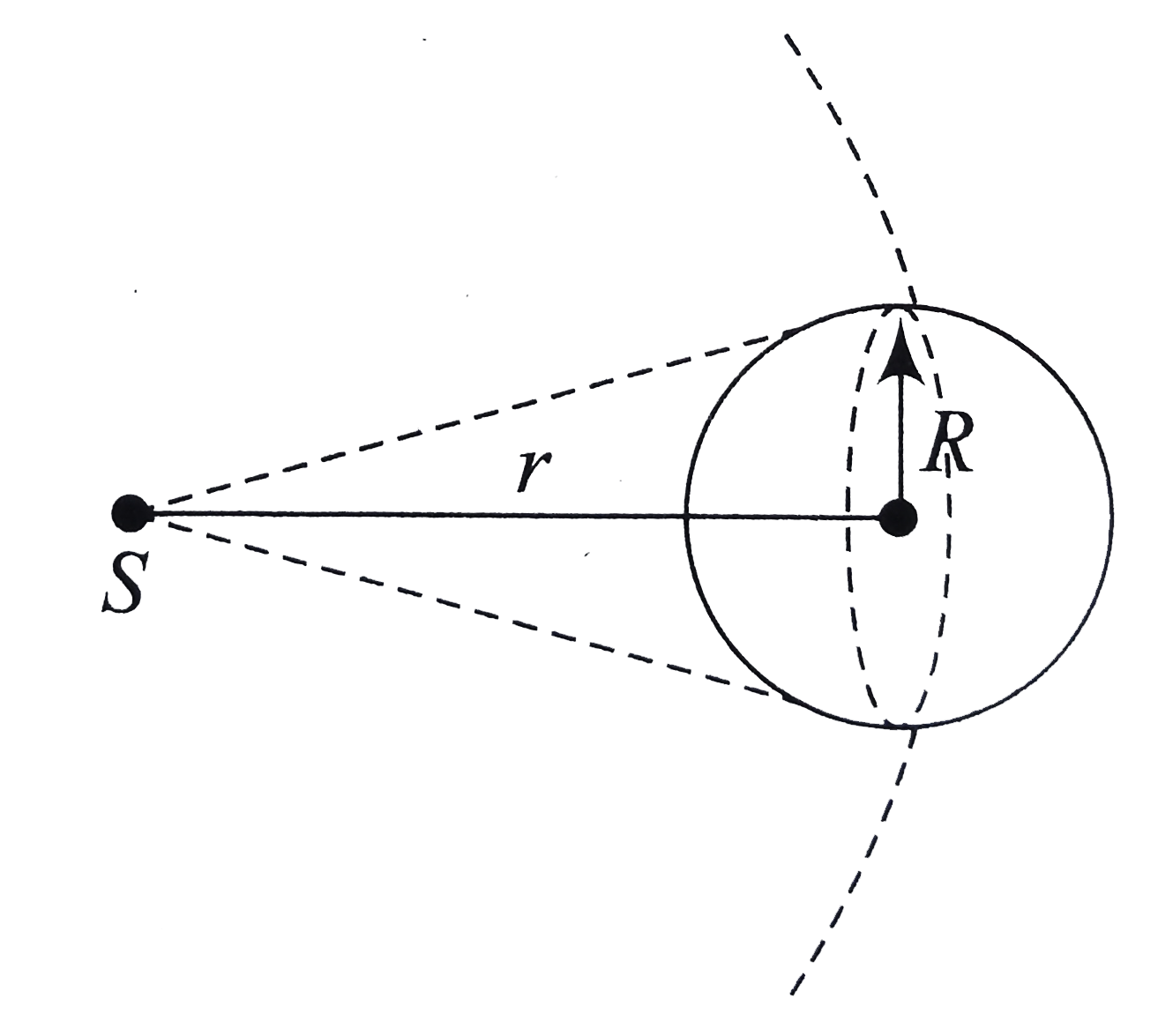 If P is the power of point source of light, the intensity at a distance r is `I=(P)/(4pir^2)` The energy intercepted by themetallic sphere is `E=` intensity `xx` projected area of sphere `=(P)/(4pir^2)xxpiR^2` If e is the energy of the single PHOTON and `eta` the efficiency of the photon to liberate an electron, the number of ejected electrons is `eta(PR^2)/(4r^2R)=((10^(-6))(3.2xx10^(-3))(8XX10^(-3))^2)/(4xx(0.8)xx(5xx1.6xx10^(-19)))` `=10^(5)` electron `s^(-1)` The emission of electrons from a metallic sphere leaves it POSITIVELY charged. As the potential of the charged sphere begins to rise, it attracts emitted electron. The emission of electrons will stop when the kinetic energy of the electrons if neutralised by the retarding potential of the sphere. So, we have `eV=(KE_(max)` `V=((KE_(max))/(e))` From Einstein's photoelectric equation, `KE_(max)=hv-phi=(5-3)=2 eV` The potential of a charged sphere is `V=(1)/(4piepsi_0)(q)/(R)=(1)/(4piepsi_0)((n e)/(R))` `(1)/(4piepsi_0)((n e)/(R))=2` `n=(4piepsi_(0)2R)/(e)` `(2xx8xx10^(-3))/(9xx10^(9)xx1.6xx10^(-19))=1.11xx10^(7)` The photoelectric EFFECT will stop when `1.11xx10^(7)` electrons have been emitted. The time taken by it to emit `1.11xx10^(7)` electrons, `t=(1.11xx10^(7))/(10^(5))=111 s=1.85` min |
|