

Saved Bookmarks
| 1. |
In a quark model of elementary particles a neutron is made of one up quarksis made of one up quarks [ charge (2)/(3) e ] and two down quarks [ charges -(1)/(3) e ]. Assume that they have a triangle configuration with slde length of the order of 10^(-15) m. Calculate electrosatic potential energy of neutron and compare it with it, mass 939 MeV. |
|
Answer» Solution :Electrostatic potential energy `U= (kq_(1)q_(2))/(R)` The system of three charges is as below `r = 10^(-15) ` m `q_(u)` = up QUARKS =`(2)/(3)` e 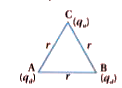 qd = down quarks = `-(1)/(3)` e Electrostatic potential energy `U = k ((qdqd)/(r)+(quqd)/(r)+(quqd)/(r))` `U=k[((-(1)/(3)e)(-(1)/3e))/(r)+(((2)/3e)(-(1)/(3)e))/(r)+(((2)/(3)e)(-(1)/(3)e))/(r)]` `U=(k)/(r)[(1)/(9)e^(2)-(2)/(9)e^(2)-(2)/(9)e^(2)]` `= (ke^(2))/(9r)xx(-3)` `=(9xx 10^(9)xx(1.6xx10^(-19))^(2)xx(-3))/(9xx10^(-15))` `=-7.68xx10^(-14)`J `: U=(-7.69xx10^(14))/(-1.6xx10^(-19))eV` `:.U= 4.8xx10^(5)` eV `= 0.48xx10^(6) eV= 0.48` Me V The ratio of potential energy of neutron to its mass is `(U)/(m) = (0.48xx10^(6))/(939xx10^(6))` `=0.00051112` `5.11xx10^(-4) m_(0)C^(2))` |
|