

Saved Bookmarks
| 1. |
In a series LCR circuit connected to an ac source of variable frequency and voltage V=V_(M) Vsinomega t,draw a plot showing the variation of current (l) with angular frequency (omega) for two different values of resistance R_(1) and R_(2)(R_(1) gt R_(2)).Write the condition under which the phenomenon of resonance occurs.For which value of the resistance out of the two curves, a sharper resonance is produced? Define Q-factor of the circuit and give its significance. |
|
Answer» Solution :Figure shows the VARIATION of `i_(m)` with `omega` in a `LCR` series circuit for two values of resistance `R_(1)` and `R_(2)(R_(1) gt R_(2))` The CONDITION for RESONANCE in the `LCR` circuit is. `omega_(0)=1/sqrt(LC)` We see that the current amplitude is maximum at the resonant FREQUENCY `omega`.Since `i_(m)=V_(m)//R` at resonance. the current amplitude of case `R_(2)` is shaper to that for case `R_(1)`. Quality factor or simply the `Q`-factor of a resonant `LCR` circuit is defined as the ratio of voltage drop across the resistance at resonance. `Q=V_(L)/V_(R)=(omegaL)/R` Thus, finally, `Q=1/Rsqrt(L/C)` The `Q` factor determines the sharpness at resonance as for higher value of `Q` factor the tuning of the circuit and it sensivity to accept resonating frequency signals will be much higher. 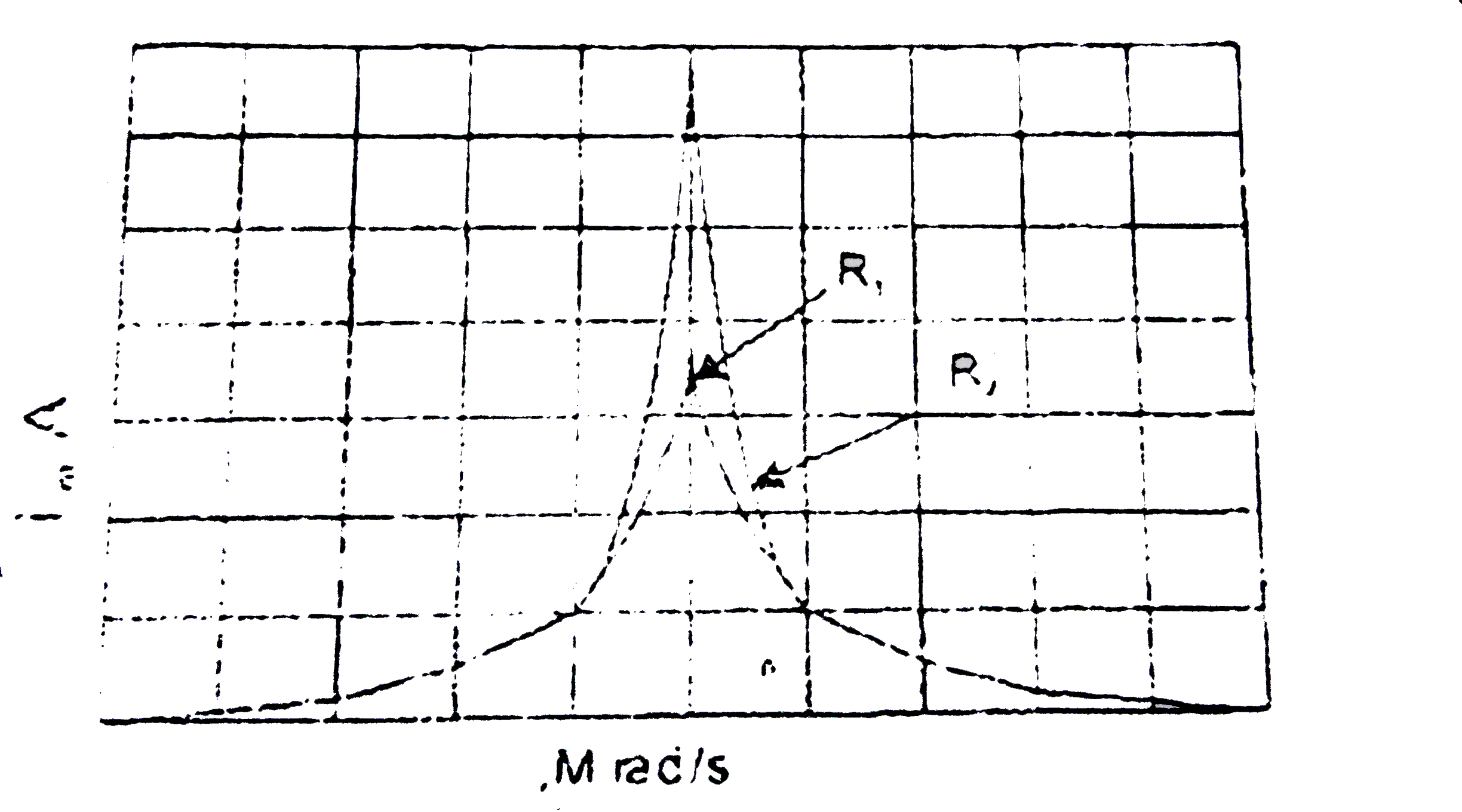
|
|