

Saved Bookmarks
| 1. |
In a series RLCAC circult, the frequency of source can be varied. When frequency is varied gradually in one direction from f_1 to f_2, the power is found to be maximum at f_1. When frequency is varied gradually at the other direction from f_1 to f_3 , the power is found to be same at f_1 and f_3. Match the proper entries from column-2 to column-1 using the codes given below the columns,(consider f_1 gt f_2) {:("Column-I",,"Column-II"),("when the frequency is equal to",,"The circuit is or can be"),("AM: arithmatic mean GM:geometic mean",,),("(P) AM of "f_(1) and "f"_(2),,"(1) capacitance"),((Q) "GM of "f_(1) and "f"_(3),,"(2) inductive"),("(R) AM of " f_(1) and "f"_(3),,"(3) resistive"),("(S) GM of " f_(1) and "f"_(3),,"(4) at resonance"):} |
|
Answer» `{:(,P,Q,R,S),((A),4,3,2,4):}` 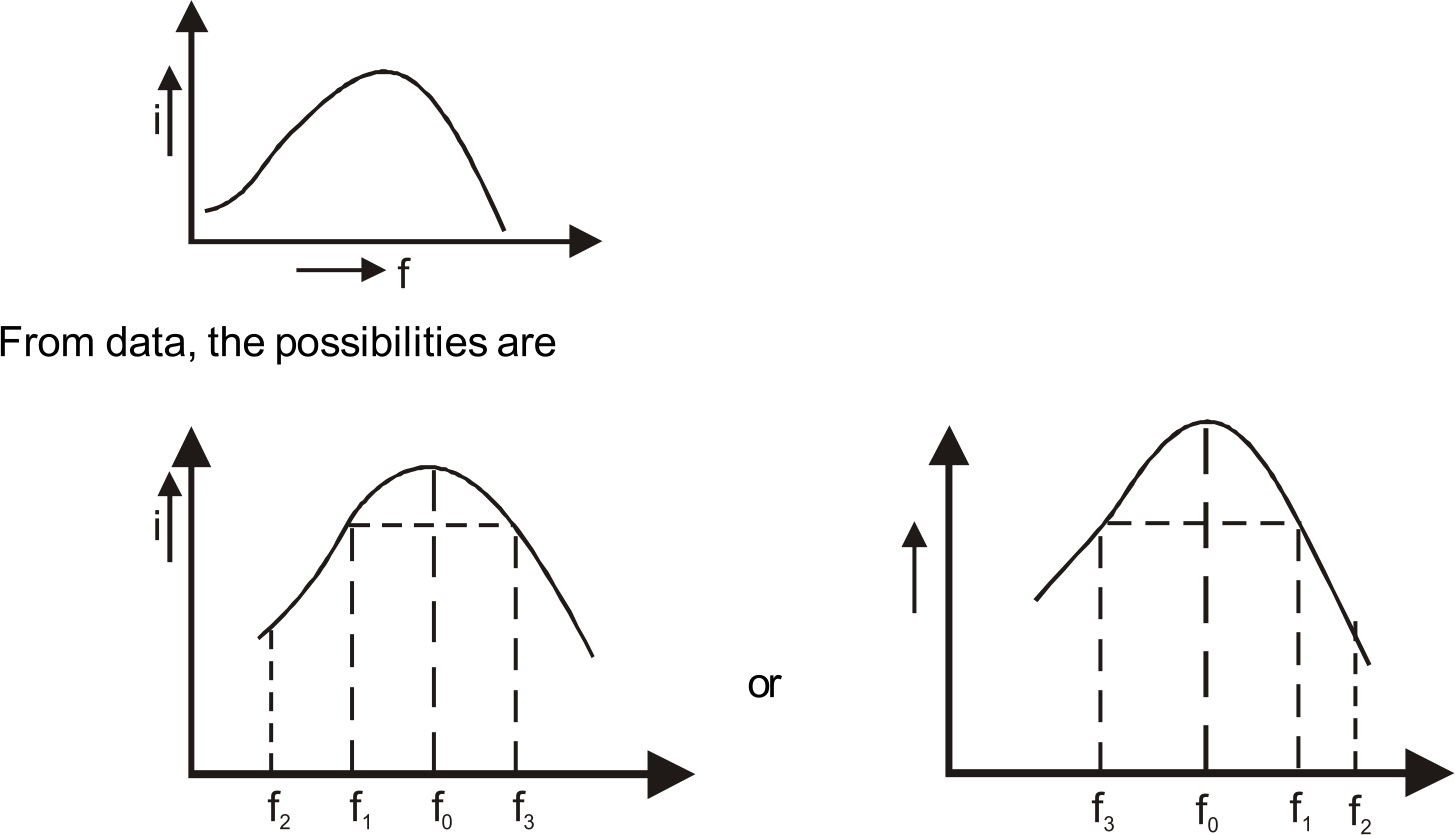 `f_(0)` is resonant frequency `RARR ` means as CIRCUIT being resistive. The circuit is capacitive when `f lt f_(0)` and inductive when `f gt f_(0)` Power at `f_(1)` and `f_(3)` same `rArr` is same `rArr` z same `rArr 2pi f_(1)L-1/(2pif_(1)C)=1/(2pif_(3)C)-2pif_(3)L` `rArr 2piL(f_(1)+f_(3))=1/(2piC)(1/(f_(1))+1/(f_(3)))` `rArr f_(1)f_(3)=1/(4pi^(2)LC)rArr sqrt(f_(1)f_(3))=1/(2pisqrt(LC))=(omega_(0))/(2pi)` `AM gt GM rArr (f_(1)+f_(3))/2 gt f_(0)` `rArr ` inductive at frequency =`(f_(1)+f_(3))/2` |
|