

Saved Bookmarks
| 1. |
In above question, if cavity is not concentric and centred at point P then repeat all the steps. |
|
Answer» Solution :Again assume `rho` and `-rho` in the cavity, (similar to the previous EXAMPLE) : (i) `vec(E_(A))=vec(E_(rho))+vec(E_(-rho))=(rho [vec(OA)])/(3 epsi_(0))+((-rho)vec(PA))/(3 epsi_(0))` `rho/(3 epsi_(0)) [vec(OA)-vec(PA)]=rho/(3 epsi_(0)) [vec(OP)]` Note : Here, we can can see that the electric field INTENSITY at point A is independent of position of point a inside the cavity. Also the electric field is ALONG the line joining the centres of the sphere and the spherical cavity. (ii) `vec(E_(B))=vec(E_(rho))+vec(E_(-rho))=(rho(vec(OB)))/(3 epsi_(0))+(K[4/3pir^(3)(-rho)])/([PB]^(3)) vec(PB)` (iii) `vec(E_(C))=vec(E_(rho))+vec(E_(-rho))=(K[4/3pi R^(3) rho])/([OC]^(3)) vec(OC)+ (K[4/3 pir^(3) (-rho)])/([PC]^(3))vec(PC)` (iv) `vec(E_(O))=vec(E_(rho))+vec(E_(-rho))=0+ (K[4/3 pi r^(3) (-rho)])/([PO]^(3)) vec(PO)` 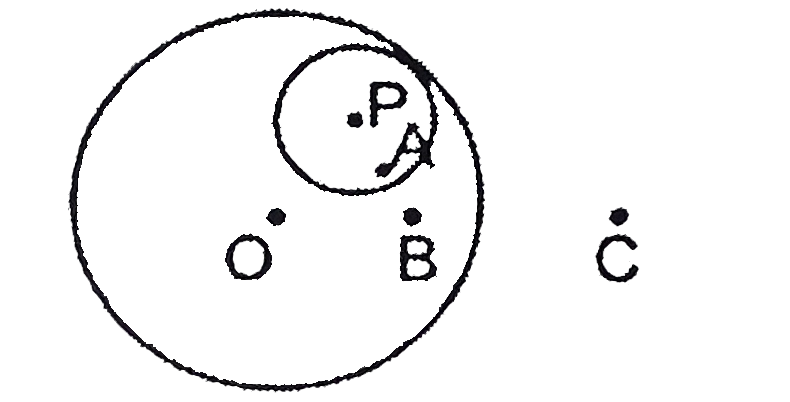
|
|