

Saved Bookmarks
| 1. |
In Fig. 8-15b, an 8.0 kg block slides along a frictionless floor as a force acts on it, starting at x_(1)=0 and ending atx_(3) = 6.5m. As the block moves, the magnitude and direction of the force varies according to the graph shown in Fig. 8-15a. Forexample, from x = 0 to x = 1 m, the force is positive (in the positive direction of the x axis) and increase in magnitude from 0 to 40 N. And from x = 4 m to x = 5, the force is negative and increases in magnitude from 0 to 20 N. (Note that this latter value is displayed as -20 N.) The block's kinetic energy atx_(1) is K_(1)=280 J. What is the block's speed at x_(1) = 0, x_(2)=4.0m, and x_(3) = 6.5 m ? |
|
Answer» Solution :KEY IDEAS (1) At any POINT, we can relate the speed of the block to its kinetic energy with EQ. 8-1 `(K=1//2mv^(2))`. (2) We can relate the kinetic energy `K_(f)` at a later point to the initial kinetic `K_(i)`and the work W done on the block by using work-kinetic energy theorem of Eq. 8-10 `(K_(f)-K_(i)=2)`. (3) We can calculate the workk W done by a variable force F(X) by integrating the force versus position x.Equation 8-32 tells us that `W = int_(x_(i))^(x_(f)) f (x)dx`. We do not have a functon F(x) to carry out this INTEGRATION, but we do have a graph of F(x) where we an integrate by finding the area between the plotted line 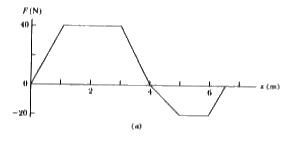 Figure 8-15 (a) A graph indicating the magnitude and direction of a variable force that acts on a block as it moves along an x axis on a floor. (b) The location of the block at several times. and the x axis. Where the plot is obove the axis, the work (which is equal to the area) is positive. Where it is below the axis, the work is negative. Calculations: The requested speed at x=0 is easy because we already Know the kinetic energy. So, we just plug the kinetic energy into the fromula for kinetic energy: `K_(1) = 1/2 mv_(1)^(2), 280 J = 1/2 (8.0 kg) v_(1)^(2)`, and then `v_(1)= 8.37 m//s ~~ 8.4 m//s`. As the block moves from x = 0 to x = 4.0 m, the plot in Figure 8-15a is above the x axis, which means that positive work is being done on the block. We split the area under the plot into a triangle at the left, a rectangle in the center, and a triangle at the right. Their total area is `1/2 (40 N) (1m) + (40 N)(2m) +1/2 (40 N) (1m) = 120 N*m` `=120J`. This means that between x = 0 and x = 4.0 m, the force does 120 J of work on the block, increasing the block reaches x = 4.0 m, the work-kinetic energy theroem tells us that the kinetic energy is `K_(2) = K_(1) +W = 280 J + 120 J = 400 J`. Again using the definition of kinetic energy, we find `K_(2) = 1/2 mv_(2)^(2), 400 J = 1/2 (8.0 kg)v_(2)^(2)`, and then `v_(2) = 10m//s` This is the block.s greatest speed because from x = 4.0 m to x = 6.5 m the force is negative, meaning that it opposes the block.s motion, doing negative work on the block and thus decrasing the kinetic energy and speed. In that range, the area between the plot and the x axis is `1/2(20N) (1m) +(20N)(1m) + 1/2 (20 N ) (0.5 m) = 35 N*m` `= 35J`. This means that the work done by the forcein that range is -35 J. At x =4.0 m, the block .s K =400 J. At x =6.5 m, the work-kinetic energy theroem tells us that its kinetic energy is `K_(3) = K_(2) +W = 400 J - 35 J = 365 J`. Again using the definition of kinetic, we find `K_(3) = 1/2 mv_(3)^(2), 365 J = 1/2 (8.0 kg)v_(3)^(3)`, and then `v_(3) = 9.55 m//s ~~ 9.6 m//s`. The block is still moving in the positive direction of the x axis, a bitfaster than initally. |
|