

Saved Bookmarks
| 1. |
In Fig. a cockroach with mass m rides on a disk of mass 6.00 m and radius R. The disk rotates like a merry-go-round around its central axis at angular speed omega_(i)=1.50rad//s. The cockroach is initially at radius r = 0.800R, but then it crawls out to the rim of the disk. Treat the cockroach as a particle. What then is the angular speed? |
|
Answer» Solution :(1) The cockroach.s crawl changes the mass DISTRIBUTION of the cockroach-disk system. (2) The angular momentum of the system does not change because there is no EXTERNAL torque to change it. (3) The magnitude of the angular momentum of a rigid body or a particle is given by Eq. `(L=Iomega)`. Calculations: We want to find the FINAL angular speed. Our key is to equate the final angular momentum `L_(f)` to the initial angular momentum `L_(i)`, because both involve angular speed. They also involve rotational inertia I. So, let.s start by finding the rotational inertia of the system of cockroach and disk before and after the crawl. The rotational inertia of a disk rotating about its central axis is given by `1//2MR^(2)`. Substituting 6.00 m for the mass M, our disk here has rotational ineria `I_(d)=3.00mR^(2)` 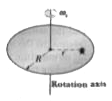 From Eq., we know that the rotational inertia of the cockroach is equal to `mr^(2)`. Substituting the cockroach.s initial RADIUS (r = 0.800R) and final radius (r = R), we find that its initial rotational inertia about the rotation axis is `I_(ci)=0.64mR^(2)` and its final rotational inertia about the rotation axis is `I_(cf)=mR^(2)` So, the cockroach-disk system initially has the rotational inertia `I_(i)=I_(d)+I_(ci)=3.64mR^(2)`, and finally has the rotational inertia `I_(f)=I_(d)+I_(cf)=4.00mR^(2)` Next, `(L=Iomega)` to write the fact that the system.s final angular momentum `L_(f)` is equal to the system.s initial angular momentum `L_(i)`: `I_(f)omega_(f)=I_(i)omega_(i)` or `4.00mR^(2)omega_(f)=3.64mR^(2)(1.50rad//s)`. After canceling the unknowns m and R, we COME to `omega_(f)=1.37rad//s`. |
|