

Saved Bookmarks
| 1. |
In Fig. , two point sources S_1 and S_2 which are in phase and separated by distance D = 1.5 lamda , emit identical sound waves of wavelength lamda.(a) What is the path length difference of the waves from S_1 and S_2 at point P_1,which lies on the perpendicular bisector of distance D, at a distance greater than D from the sources ? (That is, what is the difference in the distance from source S_1 to point P_1 and the distance from source S_2 to P_1?) What type of interference occurs at P_1 ? (b) What are the path length difference and type of interference at point P_2 in fig.(c ) Figure shows a circle with a radius much greater than D, centered on the midpoint between sources S_1 and S_2. What is the number of points N around this circle at which the interference is fully constructive? (That is, at how many points do the waves arrive exactly in phase?) |
|
Answer» Solution :(a)Because the waves travel identical distances to reach `P_1` their path length difference is `Delta L = theta ` From Eq., this means that the waves undergo FULLY constructive interference at `P_1` because they start in phase at the sources and reach `P_1` in phase. (b)The wave from `S_1` travels the extra distance D(=1.5`lamda`) to reach `P_2` Thus, the path length difference is `DeltaL = 1.5 lamda` this means that the waves are exactly out of phase at `P_2` and undergo fully destructive interference there. 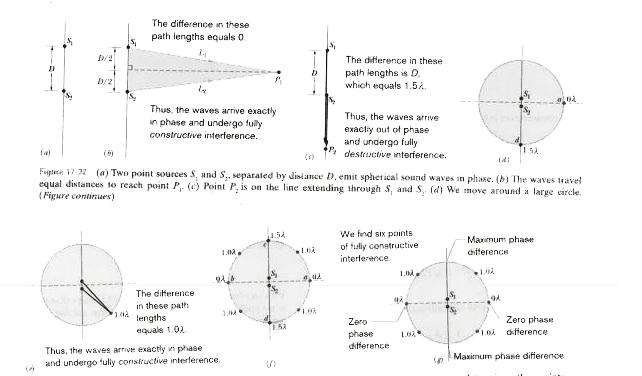 (c )STARTING at point a, let.s move CLOCKWISE along the circle to point d. As we move, path length difference `DeltaL`increases and so the type of interference changes. From (a), we know that is `Delta L = 0 lamda` at point a. From (b), we know that `Delta L = 1.5 lamda ` at point d. Thus, there must be one point between a and d at which `Delta L = lamda ` From Eq. , fully constructive interference occurs at that point. Also, there can be no other point along the way from point a to point d at which fully constructive interference occurs, because there is no other integer than 1 between 0 at point a and 1.5 at point d.We can now use symmetry to locate other points of fully constructive or destructive interference. Symmetry about LINE cd gives us point b, at which `Delta L = 0lamda ` . Also, there are three more points at which `Delta L = lamda` . In allwe have N = 6. |
|