

Saved Bookmarks
| 1. |
In terms of band theory, explain the difference between a conductor and a semiconductor and give one example of each. |
|
Answer» Solution :Conductor : Solids which have conductivities in the range of `10^(4)` to `10^(7)"ohm"^(-1)m^(-1)` are called conductors. Metals have conductivities of the order of `10^(7)"ohm"^(-1)m^(-1)`. The ATOMIC orbitals of metal atoms form molecular orbitals which are close in energy to each other so as to form a band. If the band is partially filled or it overlaps with a higher energy unoccupied conduction band, then electrons can easily flow to the conduction band. Semiconductor : Solids which SHOW conductivity in the range `10^(-20)` to `10^(-10)ohm^(-1)m^(-1)` are called SEMICONDUCTORS. The gap between the valence band and conduction band is small. Therefore, some electrons jump to the conduction band and show some conductivity. The FOLLOWING figure illustrates. 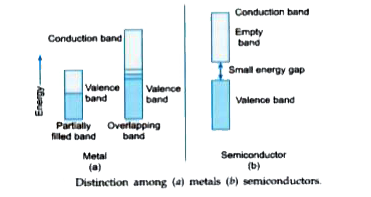
|
|