

Saved Bookmarks
| 1. |
In the circuit shown in figure initially the switch is opened. The switch is closed now. The charge that will flow in direction 1 is |
|
Answer» `-(C_(2)^(2)epsilon)/(C_1 + C_2)` 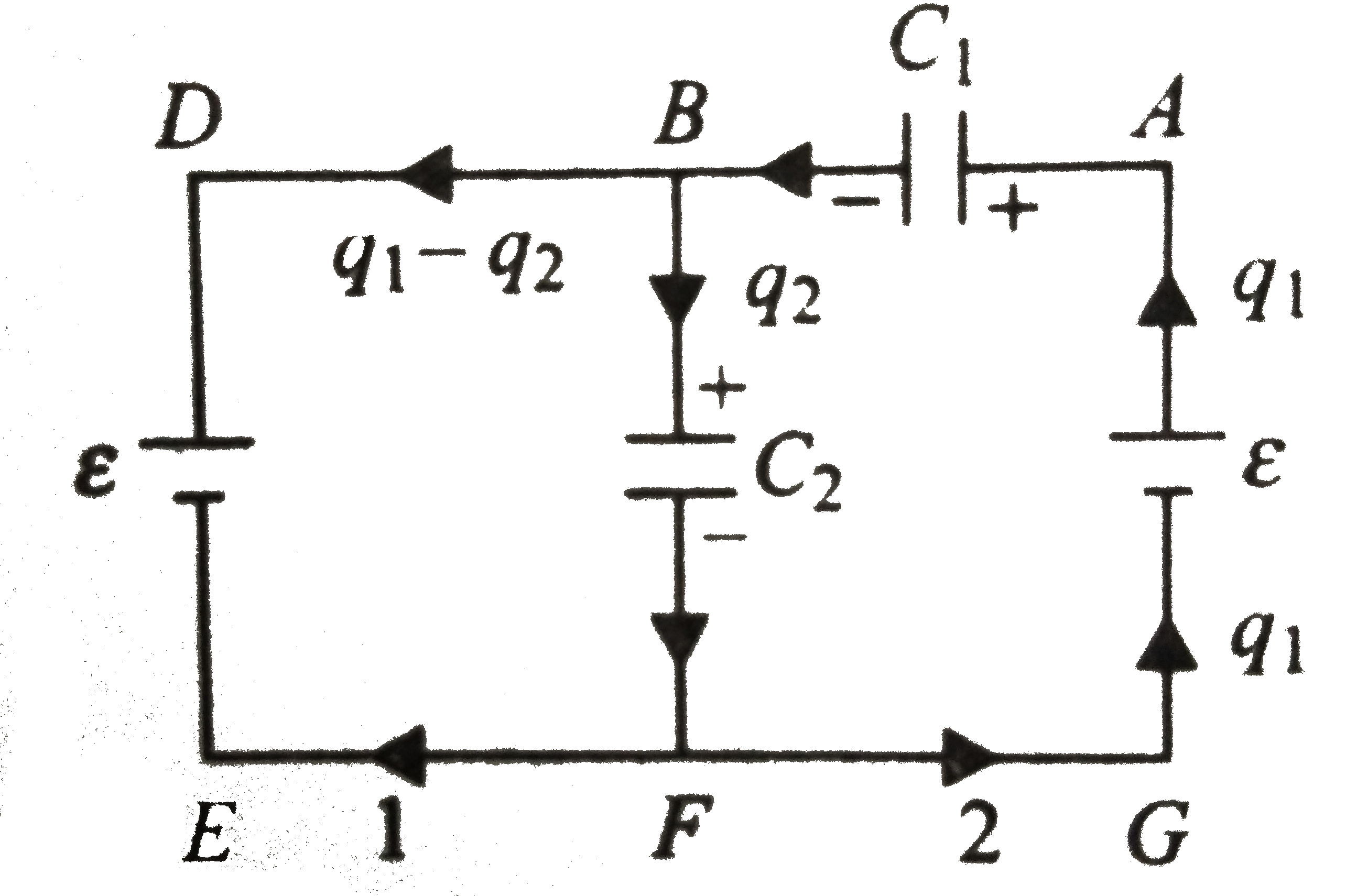 Charge on capacitors `C_(1)` and `C_(2)` before closing the SWITCH S is `q_(0)=((C_(1)C_(2))/(C_(1)+C_(2)))epsilon` After closing S, charge in `C_(2)` (final charge) is `q_(2)=C_(2)epsilon` In loop `ABBDEFGA,epsilon=0` or `q_(1)=0` ltbr. final charge on `C_(1),q_(1)=0` to make final charge in `C_(1)` the charge hence charge flown towards direction 2 is `triangleq_(2)=-((C_(1)C_(2))/(C_(1)+C_(2)))epsilon` To make charge on capacitor `C_(2)` to final VALUE `q_(2)` the charge flow into capacitor is `triangleq=C_(2)epsilon-(C_(1)C_(2))/(C_(1)+C_(2))epsilong=C_(2)epsilon[1-(C_(1))/(C_(1)+C_(2))]` `triangleq_(B)=(C_(2)^(2)epsilon)/(C_(1)+C_(2))` ltbr. at junction F, `triangleq_(1)=triangleq-triangleq_(2)=(C_(2)epsilon)/(C_(1)+C_(2))[C_(2)+C_(1)]=C_(2)epsilon` Alternative method: fig in loop `ABDEG,-((q_(0)+triangleq_(1)))/(C_(1))-epsilon+epsilon=0` or `tringleq_(1)=-q_(0)=-(C_(1)C_(2)epsilon)/(C_(1)+C_(2))` in loop BFEDB, `-((q_(0)+triangleq_(1)))/(C_(2))+epsilon=0` or `triangleq=C_(2)epsilon-q_(0)` At junction F `triangleq_(2)=triangleq_(1)-triangle_(Q)=-q_(0)-(C_(2)epsilon-q_(0))=-C_(2)epsilon` Hence charge flow in the direction of `(1) is -(C_(1)C_(2)epsilon)/(C_(1)+C_(2))` (2). is `C_(2)epsilon` |
|