

Saved Bookmarks
| 1. |
In the figure masses m_(1), m_(2) and M are 20 kg, 5 kg and 50 kg, respectively. The co-efficient of friction between M and ground is zero. The co-efficient of friction between m_(1) and M and that between m_(2) and ground is 0.3. The pulleys and the string are massless. The string is perfectly horizontal between P_(1) and m_(1)and also between P_(2) and m_(2). The string is perfectly vertical between P_(1)and P_(2). An external horizontal force F is applied to the mass M. Take g=10m//s^(2). (a) Draw a free body diagram for mass M, clearly showing all the forces. (b) Let the magnitude of the force of friction between m_(1) and M be f_(1) and that between m_(2) and ground be f_(2). For a particular F, it is found that f_(1)=2f_(2). Find f_(1) and f_(2). Write down equations of motion of all the masses. Find F, tension in the string and accelerations of the masses. |
Answer» Solution :(a)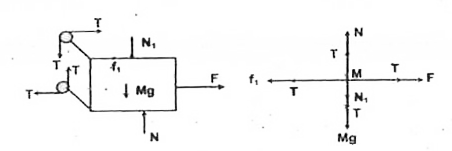 (b) We CONSIDER the following cases: (i) All the three blocks are moving and `m_(1)` moves relative to M. In this CASE, `(f_(1))_("max")= mu_(1)N_(1)=mu_(1)m_(1)g=0.3 xx 20xx10=60N` `(f_(2))_("max")=mu_(2)m_(2)g=0.3xx5xx10=15N` Given that `f_(1)=2f_(2)"or" f_(2)=f_(1)//2` The maximum value of `f_(2)` is 15N so `f_(1)` cannotbe more than 30N. This case is not possible. So, `m_(1)`remain at rest w.r.t. M. (ii) All three blocks are at rest. Now, `F-f_(1)=0, T=f_(1) and T=f_(2)` So, `f_(1)=f_(2)"" ` (not possible) (iii) All the three blocks are moving with same acceleration .a.. In this case, Equation for `M:F-f_(1)=Ma` Equation for `m_(1):f_(1)-T=m_(1)a` Equation for `m_(2):T-f_(2)=m_(2)a` `f_(1)=2f_(2)=15xx2` Solving, we get `a=0.6m//s^(2), F=60N, T=18N, f_(2)=15N, f_(1)=30N`. |
|