

Saved Bookmarks
| 1. |
In the figure shown co-efficient of friction between the block B and C is 0.4. There is no friction between the block C and hte surface on which it is placed. The system of blocks is released from rest in the shown situation. Find the distance moved by the block C when block A descends through a distance 2m. Given masses of the blocks are m_(A)=3 kg, m_(B)=5 kg and m_(C)=10 kg. |
Answer» Solution :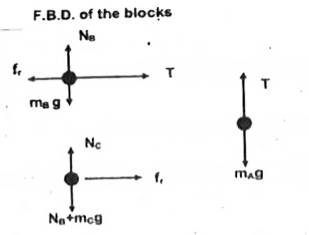 Let there is no relative motion between the blocks B and C Hence `T=(m_(B)+m_(C))a"" ...(1)` And`m_(A)g-T=m_(A)a ""...(2)` From (1) and (2), we get `a=(m_(A)g)/(m_(A)+m_(B)+m_(C))=(30)/(18)=(5)/(3)m//s^(2)` `rArr` Net force on the block C is, `F=m_(c)a=10xx(5//3)N=16.6N` If maximum value of FRICTIONAL force acting on block C is`f_("MAX")`, then `f_(("max"))=mu m_(B)g=0.4xx5xx10=20N "" because F le f_("max")` Hence there is no relative between the block B and C. Therefore distance moved by C is 2M only. |
|