

Saved Bookmarks
| 1. |
In the figure three are three metallic large plates. The middle plates carries a total charge q. Plates 1 & 2 (which are uncharged) are connected by a wire. Find the charge induced on each surface of 1 & 2. Given l_(2) = 2l_(1) |
|
Answer» `RARR q_(3)-q_(1)+q_(1)-q+q_(3)=0` `rArr q_(3)=1//2` (1) & (2) have same potential `rArr (q_(1)l)/(A epsilon_(0))-((q-q_(1)))/(A epsilon_(0))2 l=0` `rArr -q_(1)+(q-q_(1))2=0` `rArr -3 q_(1)+(q-q_(1))2=0` `rArr -3q+2q =0` `q_(1)=-(2q)/(3)` Alternative Solution : Let the charge on ourter surface of plates (1) be x and on the inner (interfacing) surface of plate )1_ be y, then charge distribution on other plates is shown in figure (by using charge conservation and E = 0 INSIDE the metallic plates) For electric FIELD to be zero inside the plate 1 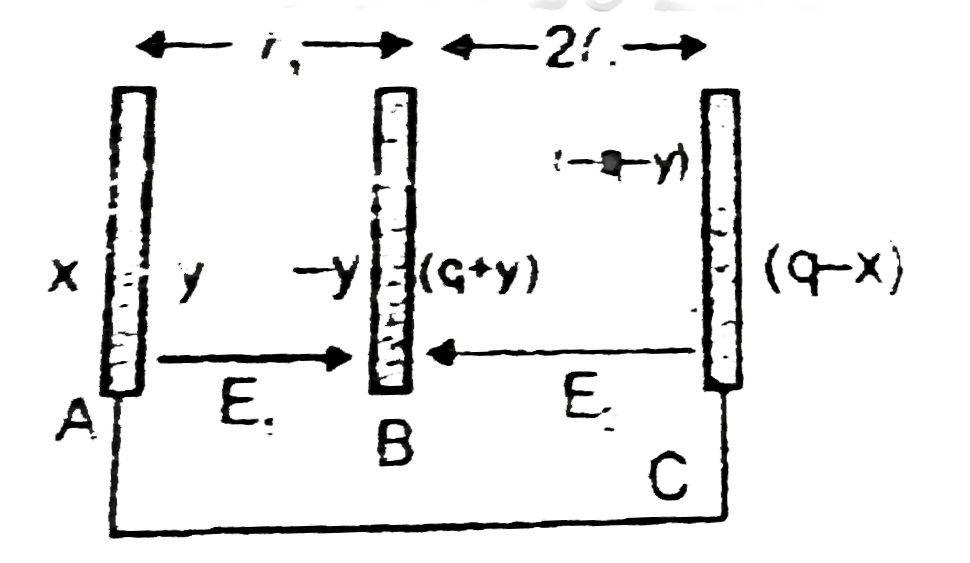 `=(x)/(2A epsilon_(0))=((q-x))/(2A epsilon_(0))` `rArr x=(q)/(2) & q-x =(q)/(2)` SINCE `V_(A) =V_(C) rArr V_(A) - V_(B) = V_(C) - V_(B)` `rArr E_(1) l_(1) = E_(2) l_(2)` `rArr = (y)/(A epsilon_(0)) l_(1) ((-q-y))/(A epsilon_(0)) 2 l_(1)` `y l_(1)=2ql_(1)-2yl_(1)rArr3yl_(1)=-2yl_(1)y =(-2q)/(3)` So, `-q-y=-q+(2q)/(3)=(-q)/(3)` So, charge on outer surface of plate 1 is `x = (-q)/(2)` Charge oninner (interfacing) surface of plate 1 is `y = (-2q)/(3)` Charge onouter surface of plate 2 is `q - x = (q)/(2)` Charge on inner (interfacing) surface of plate 2 is `(-q-y)=(-q)/(3)` `q_(1("outer"))=(1)/(2),q_(1("inner"))=(-2q)/(3)` `q_(2("outer"))=(q)/(2),q_(2("inner"))=(-q)/(3)`. |
|