

Saved Bookmarks
| 1. |
In the following diagram, the arm PQ of the rectangular conductor is moved from x = 0 , outwards. The unfirom magnetic field is perpendicular to the plane and extends from x=0 to x=b and is zero for xgtb. Only the arm PQ possesses substantial resistance 'r'. Consider the situation when the arm PQ is pulled outwards from x = 0 to x = 2b, and then moved back to x = 0 with constant speed 'v'. Obtain expressions from the (i) magnetic flux, (ii) the induced emf, (iii) the force necessary to pull the arm and (iv) the power dissipated as joule heat. Sketch the variation of these quantities with distance. |
|
Answer» <P> Solution :As per FIGURE given with the question let us first consider the forward motion from x= 0 to x = 2b.(i) Magnetic flux `phi_(B)` linked with the circuit SPQR will be `phi_(B)=Blx` for `0lexleb` and `phi_(B)=Blb" for "b le x le 2b`. (II) The induced emf `epsilon=(dphi_(B))/(dt)` is `epsilon=-Blv" for "0lexleb` `and epsilon=0" for "b le x le 2b`. (iii) When `epsilon` is non - zero induced current `I=(epsilon)/(r)`. `therefore` Force required to keep the arm PQ in constant NOTION will be `F=IlB` towards left. Thus, `F=(B^(2)l^(2)v)/(r) " for "0lexleb and F = 0 " for " b le x le 2b` (IV) Power dissipalated as Joule heat `P=I^(2)r` So, `P=(B^(2)l^(2)v^(2))/(r)" for "0lexleb` and `P=0" for "b le x le 2b.` For inward motion from x = 2b to x = 0, we get similar results. The variation of `phi_(B), E, F and P` with x si shown in the figure. 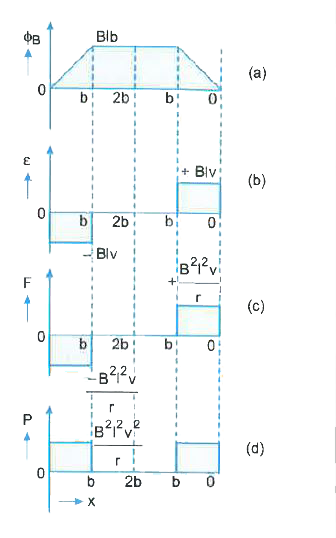
|
|