

Saved Bookmarks
| 1. |
In the given electric circuit find (a) current (b) power output (c ) relation between r and R so that the electic power output (that means power given to R) is maximum. (d) value of maximum power output. ( e) plot graph between power and resistanace of load (f) From graph we see that for a given power output there exists two values of external resistance, prove that the product of these resistances equals r^(2). (g) what is the efficiency of the cell when it is used to supply maximum power. |
|
Answer» Solution :(a) In the circuit shown if we assume that potential at A is zero then potential at A is zero then potential at B is `EPSI-ir`. Now SINCE the connecting wires are of zero resistance `thereforeV_(D)=V_(A)=0rArrV_(C)=B_(B)=epsi-ri` Now current through CD is also i (because it's in series with the CELL). `therefore i=(V_(C)-V_(D))/R=((epsi-ir)-0)/R"Current i"=epsi/(r+R)` Note : After learning the concept of series combination we will be able to CALCULATE the current directly (b) Power output `P=i^(2)R=epsi^(2)/((r+R)^(2))R` ( c) `(dp)/(dR)=epsi^(2)/((r+R)^(2))-(2epsi^(2)R)/((r+R)^(3))[R+r-2R]` 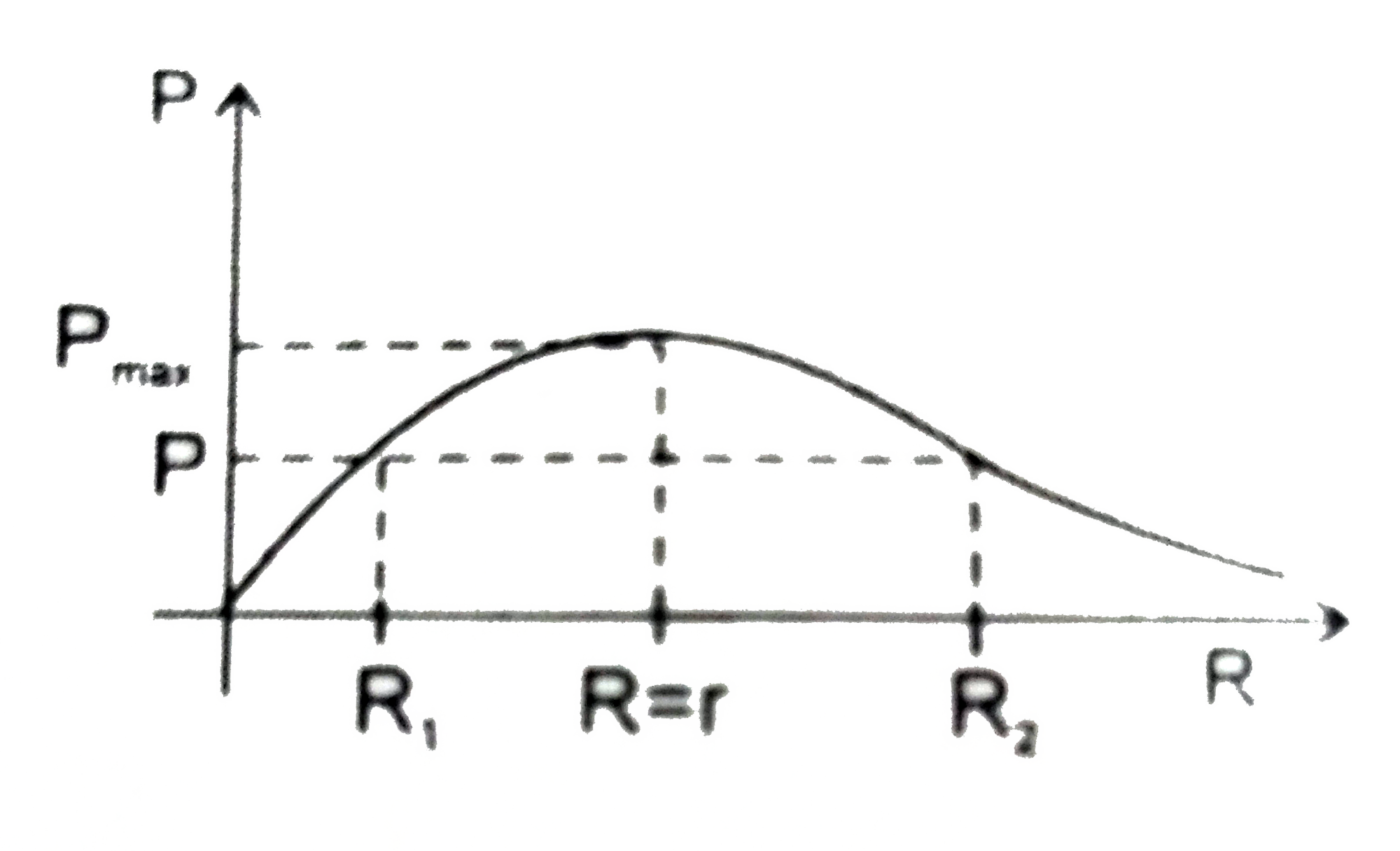 for maximum power supply `(dp)/(dR)=0` `rArr r+R-2R=0rArrr=R` Here for maximum power output outer resistance should be equal to internal resistance (d) `P_("max")=epsi^(2)/(4r)` ( e) Graph between 'P' and R maximum power output at R=r `P_("max")=epsi^(2)/(4r)rArri=epsi/(r+R)` (F) Power output `P=(epsi^(3)R)/((r+R)^(2))` `P(r^(2)+2rR+R^(2))=epsi^(2)R` `R^(2)+(2r-epsi^(2)/P)R+r^(2)=0` Above quadratic equation in R has two roots `R_(1)" and "R_(2)` for given values of `epsi,` P and r such that `thereforeR_(1)R_(2)=r_(2)("product of roots")` `r^(2)=R_(1)R_(2)` (g) Power of battery spent `=epsi^(2)/((r+)^(2)),2r=epsi^(3)/(2r)` Power (output)`=(epsi/(r+r))^(2)xxr=epsi^(2)/(4r)` `"Efficiency ="("Power output")/("total power by cell")=(epsi^(2)/(4r)xx100)/(epsi^(2)/(2r))=1/2xx100=50%` |
|