

Saved Bookmarks
| 1. |
In this problem an object is pulled along a ramp but the object starts and ends at rest and thus has no overall change in its kinetic energy ( that is important). Figure 8-10a shows the situation. A rope pulls a 200 kg sleigh ( which you may know) up a slope at incline angle theta=30^(@), through distance d=20 m. The sleigh and its contents have a total mass of 200 kg. the snowy slope is so slippery that we take it to be frictionless. How much work is done by each force acting on the sleigh ? |
|
Answer» Solution :KEY IDEAS (1) During the motion, the forces are constant in MAGNITUDE and direction and thus we can calculate the work done by each with Eq. 8-7 `(W= Fd cos phi)` in which `phi` is the angle between the FORCE and the displacement. We reach the same result with Eq. 8-8 `(W= vec(F)*vec(d))` in which we take a dot product of the force vector and displacement vector. (2) We can relate the net work done by the forces to the change in kinetic energy energy ( or lack of a change, as here) with the work-kinetic energy theorem of Eq. 8-10 `(DeltaK=W)`. Calculations: The first thing to do with most physics problems INVOLVING forces is to draw a free-body diagram to organize our thoughts. For the sleigh, Fig, 8-10b is our free-body diagram, showing the gravitational force `vec(F)_(g)`, the force `vec(T)` from the rope, and the normal force `vec(F)_(N)` from the slope. Work `W_(N)` by the normal force, Let.s start with this easy calculation. The normal force is perpendicular to the 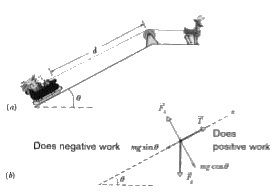 Figure 8-10 (a) A sleigh is pulled up a snowy slope. (b) The freebody diagram for the sleigh. slope and thus also to the sleigh.s displacement. Thus the normal force does not affect the sleigh.s motion and does zero work. To be more formal, we can apply Eq. 8-7 to write `W_(N)=F_(N)d cos 90^(@)=0`. Work `W_(g)` by the gravitational force. We can find the work done by the gravitational force in either of two ways (you pick the more appealing way). From an earlier discussion about ramps (Sample Problem 5.06 and Fig. 5-23), we know that the component of the gravitational force along the slope has magnitude MG `sin theta` and is directed down the slope. Thus the magnitude is `F_(gx)=mg sin theta= (200 kg) (9.8 m//s^(2))sin 30^(@)` `=980N`. The angle `phi` between the displacement and this force component is `180^(@)` . So we can apply Eq. 8-7 to write `W_(g)=F_(gx)d cos 180^(@)=(980N)(20m)(-1)` ` = -1.96xx10^(4)J`. The negative result means that the gravitational force removes energy from the sleigh. The second (equivalent) way to get this result is to use the full gravitational force `vec(F)_(g)` instead of a component. The angle between `vec(F)_(g)` and `vec(d)` is `120^(@)` (add the incline angle `30^(@)` to `90^(@)`). So, Eq. 8-7 gives us `W_(g)=F_(g)d cos 120^(@)=mgd cos 120^(@)` `=(200 kg) (9.8 m//s^(2))(20m)cos 120^(@)` `=1.96xx10^(4)J`. Work `W_(T)` by the rope.s force. We have two ways of calculating this work. The quickest way is to use the work-kinetic energy theorem of Eq. 8-10 `(DeltaK=W)`, where the net work W done by the forces is `W_(N)+W_(g)+W_(T)` and the change `DeltaK` in the kinetic energy is just zero (because the initial and final kinetic energies are the same-namely, zero). So, Eq. 8-10 gives us `0=W_(N)+W_(g)+W_(T)=0-1.96xx10^(4)J+W_(T)` and `W_(T)=1.96xx10^(4)J`. Instead of doing this, we can apply Newton.s second law for motion along the `x` axis to find the magnitude `F_(T)` of the rope.s force. Assuming that the acceleration along the slope is zero (except for the brief starting and stopping), we can write `F_("net. x")= m a_(x)`, `F_(T)-mg sin 30^(@)=m(0)`, to find `F_(T)=mg sin 30^(@)`. This is the magnitude. Because the force and the displacement are both up the slope, the angle between those two vectors is zero. So, we can now write Eq. 8-7 to find the work done by the rope.s force: `W_(T)=F_(T)d cos 0^(@) = (mg sin 30^(@))d cos 0^(@)` `=(200 kg)(9.8 m//s^(@))(sin 30^(@))(20m)cos 0^(@)` `=1.96xx10^(4)J`. |
|