

Saved Bookmarks
| 1. |
Indentigy the set of reagents/reacatns conditins (X) and (Y) in the followingset of transforamtion: CH_(3) - CH_(2) - CH_(2) Br overset((Br))(rarr) underset(Br)underset(|)underset(CH_(3)-CH-CH_(3))underset(darr (Y))("Product") |
|
Answer» `(X)` = Dilute aqueosu`NaOH, 20^(@)C` For `X`, the conditions given are: `{:(a,b,c,d),(Dil.aq.,CONC. Alcoholic,Dil.aq.,Conc. Alcoholic),(NaOH,NaOH,NaOH,NaOH),(20^@C,80^@C,20^@C,80^@):}` So conditions (a) and (c) are same and not required becuase in aq. `NAOH. SN^(2)` reaction will OCCUR to give `ROH`. [So condtions for `E2`ELIMINATION is conc. alcoholic `NaOH` at `80^(@)C` (Conditions (b) and (d) are same.)] For `Y` conditions given are: `{:(a,b,c,d),(HBr//"acetic".,HBr//"acetic",Br_(2)//CHCl_(3),Br_(2)//CHCl_(3)),("acid","acid",,),(at20^@C,at20^@C,at0^@C,at0^@):}` Conditions (c) and (d) are not required becuase they do not give the desiredproduct. Only condition for `(Y)` is `(a)` or `(b)` But for `(X)` is as in `(b)`, and conditionfor `(Y)` as in `(b)`. 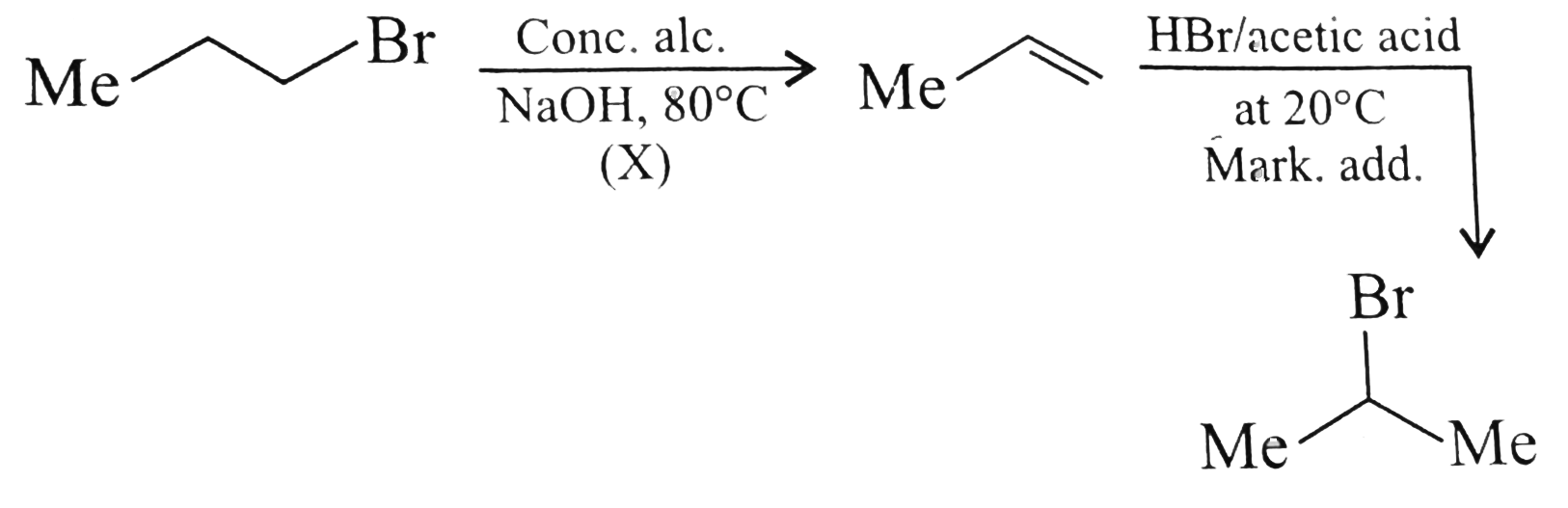
|
|