

Saved Bookmarks
| 1. |
Let us now connect two more capacitors in the circuit. One of them, C_(5), is connected in the part of thecircuit between X and A. It connected between either in series or in parallel with C_(1). The other, C_(6), is connected between A and B. It is observed X and Y hass the the same malue C_(5) is. Capacitance C_(5) is. |
|
Answer» `1.24 muF` in series with `C_(1)` `V_(4)=V_(1)` `V_(4)=17.5 V` Consider any branch say, `XAY` Since `C_(1)` and `C_(2)` are in series, charge on `C_(2)` is ALSO `35 mu C`. Using `Q = CV` for `C_(2)` `C_(2) = C = (35)/(V_(2)) = (35)/(12.5) = 2.8 mu F` Equivalent capacitance of branch `XAY` is the series equivalent of `C_(3)=C=2.8 muF` and `C_(4)=2 muF` i.e., `1.17 muF`. There branches are in parallel between `X` and `Y`, Hence equivalent capacitance between `X` and `Y` is `1.17+1.17=2.34 muF`. Capacitor `C_(5)` is connected in the part of circuit between `X` and `A` either in series or parallel with `C_(1)=2 muF`. Let the equivalent capacitance of `C_(1)` and `C_(5)`, i.e., the equivalent capacitance between `X` and `A` be `C'_(1)`. Capacitor `C_(6)` is connected between `A` and `B` Obviously, the circuit then becomes a Wheatstone bridge. Further, since equivalent capacitance between `X` and `Y` is INDEPENDENT of the value of `C_(6)`, it implies that bridge is in the balanced condition and potentials at `A` and `B`are now EQUAL, so that `(C'_(1))/C_(3)=C_(2)/C_(4)` or `(C'_(1))/(2.8)=(2.8)/2` (`C_(2)=2.8 muF`, as or determined earlier) or `C_(1)=3.92 muF` `C'_(1)` is the equivalent capacitance of `C_(1)=2 muF` and `C_(5)`, Since `C'_(1)gtC_(1)`, we can conclude that `C_(1)` and `C_(5)` are in parallel, So each individual capacitance .Hence, `C_(1)` and `C_(5)` are in parallel, so `C'_(1)=C_(1)+C_(5)` or `C_(5)=C'_(1)-C_(1)=3.92-2=1.92 muf` `V'_(1)+V_(2)=30` 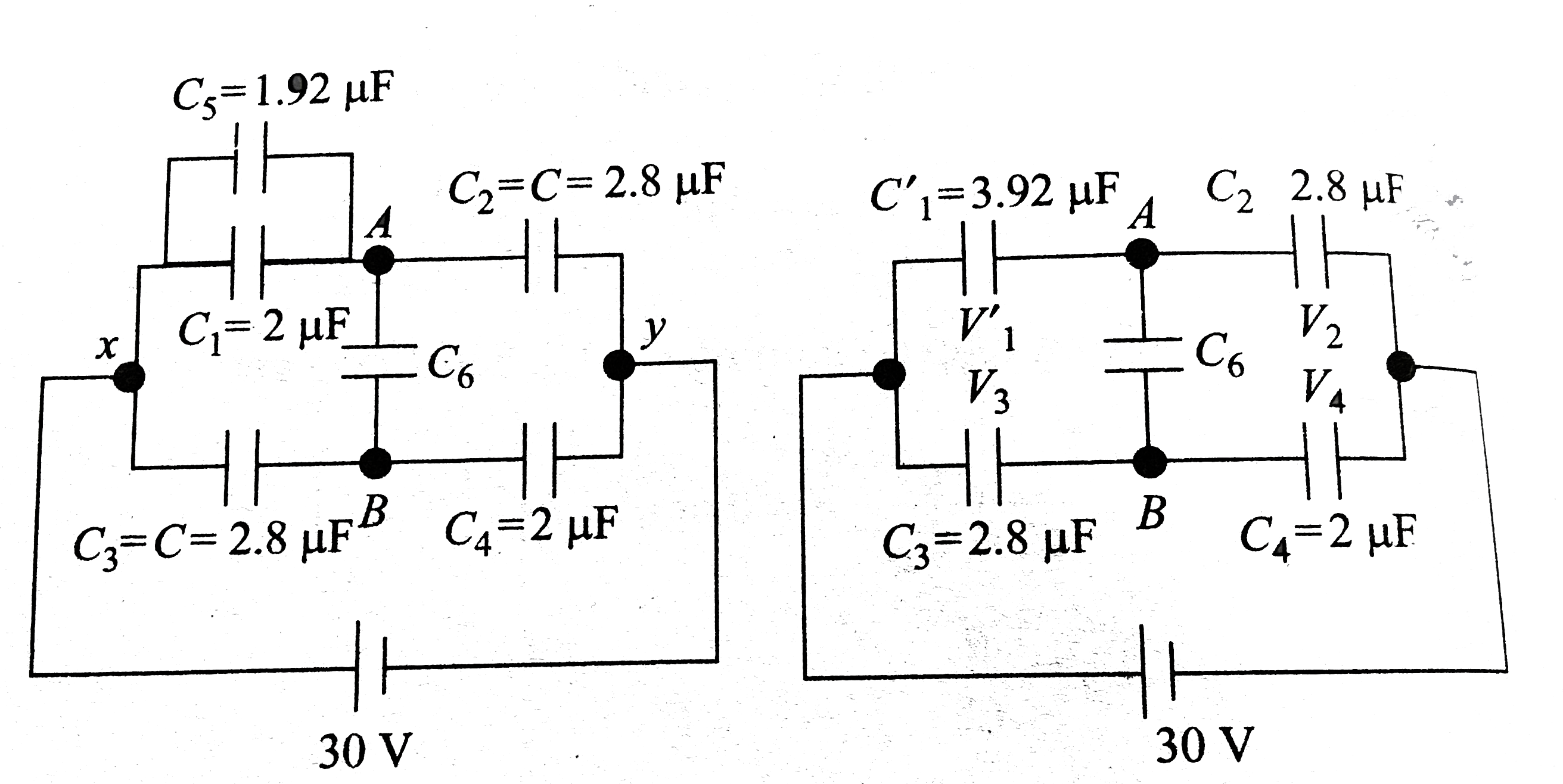 . . . . Since the bridge is in a balanced condition, `A` and `B` at same potential and `C_(6)` has zero charge. `C'_(1)` and `C_(2)` are in series. Therfore, charge on `C'_(1)` and `C_(2)` has the same value, so that potential differnce will be in the inverse ratio of capacitance [`Q=CV` or `V=Q/C "hence for same" Q,Vprop1/C']` `(V'_(1))/(V'_(2))=(2.8)/(3.92)~~0.71` or `V'_(1)=0.71 V_(2)` From Eq. (iv), `0.71 V_(2)+V_(2)=30` or `V_(2)=17.5 V` Hence `V'_(1)=30-V_(2)=12.5 V` Since `C'_(1)`, is parallel equivalet of `C_(1)` and `C_(5)`, so potential differnce across each is `V'_(1)=12.5 V`. Hence, charge on `C_(5)` is `C_(5)V'_(1)=1.92 xx12.5=24 muC`. |
|