

Saved Bookmarks
| 1. |
ltBRgt A nozzle throws a stream of gas against a wall with a velocity v much larger than the thermal agitation of the molecules. The wall deflects the molecules without changing the magnitude of their velocity. Also, assume that the force exerted on the wall by the molecules is perpendicular to the wall. (This is not strictly true of a rough wall). Find the force exerted on the wall |
|
Answer» `Anmv^2cos^2theta` 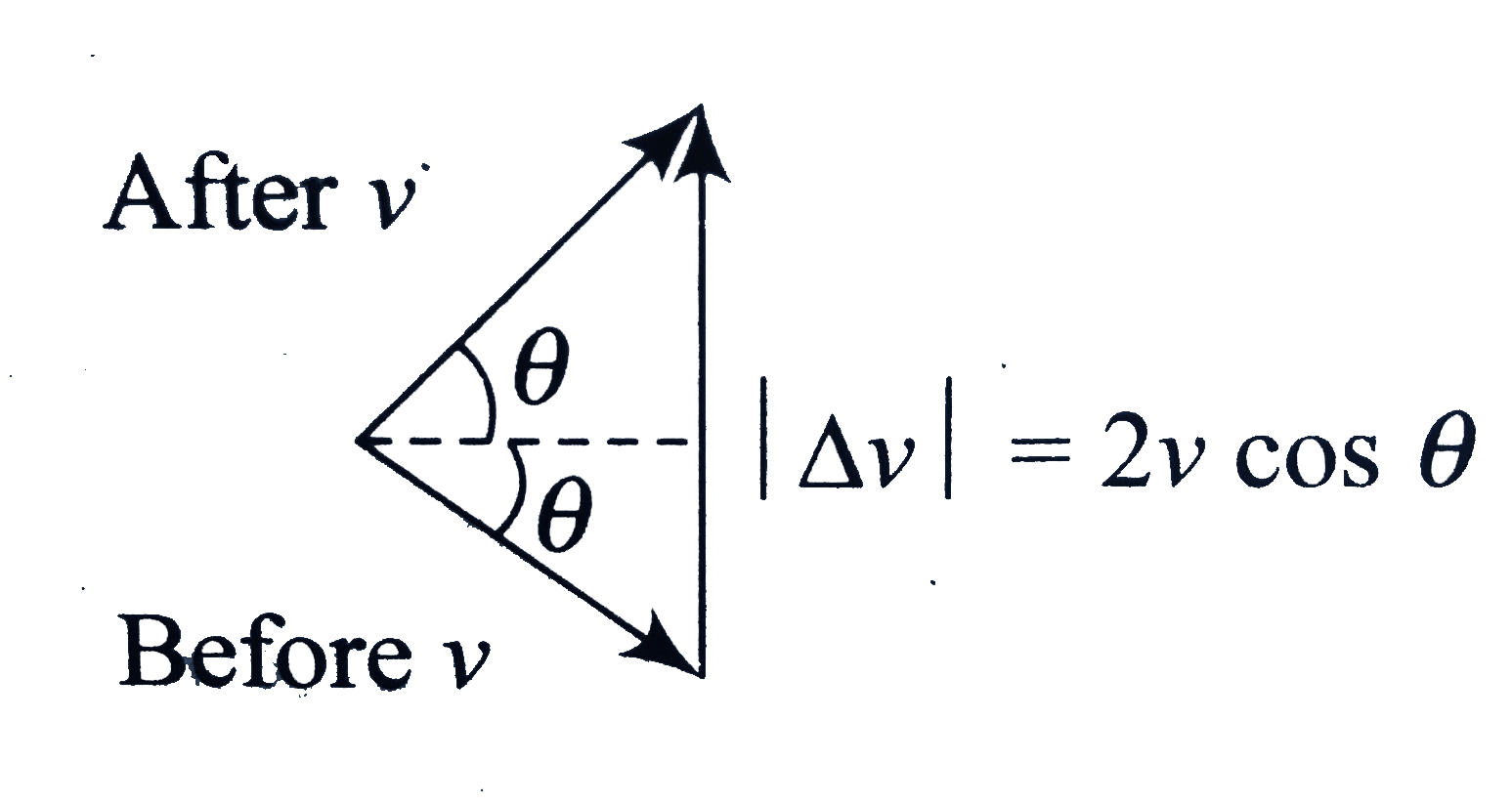 Since the molecules rebound from the wall, the component of VELOCITY perpendicular to the wall is reversed, whole its velocity parallel to the wall does not change. The change is velocity of molecules is parallel to normal N. The magnitude of change is `|trianglevecv|=2vcostheta` The change is momentum of a molecule is `|trianglevecp|=m|trianglevecv|=2mvcostheta` in the direction of normal N. Let n be the number of molecules per unit volume. The number of molecules arriving at an area A of the wall per unit time is the number in a slanted cylinder whose length is equal to the velocity v and whose CROSS section as `Acostheta`. Number of molecules`=n(Avcostheta)` Each molecule suffers a change of momentum `2mvcostheta`. Change of momentum of a steam of gas in a direction perpendicular to the wall is equal to `(nAvcostheta)xx(2mvcostheta)=2Anmv^2cos^2theta`. Hence, force EXERTED on stream of gas by the wall, `F=2Anmv^2cos^2theta` This is also the force exerted by gas molecules on the wall. pressure=(normal force)/(Area)`=(F)/(A)=2nmv^2cos^2theta` REMARK: for oblique incidence, the change in momentum of the radiation per unit volume at the perfectly reflecting surface is `2pcostheta` and the corresponding radiation pressure is `P_(rad)=2pccos^2theta=2Ecos^2theta` |
|