

Saved Bookmarks
| 1. |
Match the reaction in Column I with nature of the reactions/type of the products in Column II. {:("Column I","Column II"),((A)AgNO_3(aq)+I_2(s)("excess")+H_2O (l)to,(p)"Redox reaction"),((B)CrO_4^(2-)(aq)+H^+(aq)to,(q)"One of the products has trigonal planar structure"),(( C)MnO_4^(-)(aq)+NO_2^(-)(aq)+H^+(aq)to,"(r)Dimeric bridged tetrahedral metal ion"),((D)NO_3^(-)(aq)+H_2SO_4(aq)+Fe^(2+)(aq)to,"(s)Disproportionation"),(,"(t)Colour of one of the products is due to charge transfer spectrum"):} |
|
Answer» It is disproportionation and redox reaction. `NO_3^-` has planar structure. 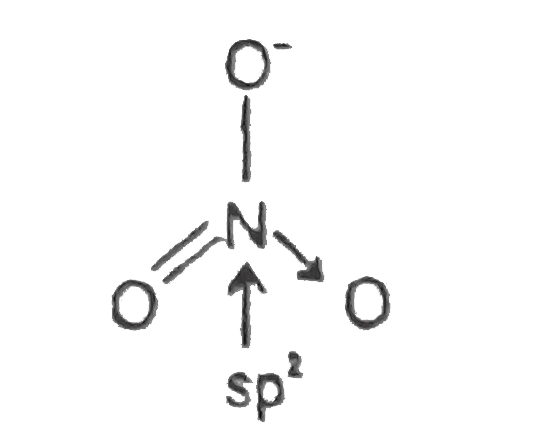 (B)`2CrO_4^(2-)+H^+ toCr_2O_7^(2-)+H_2O` 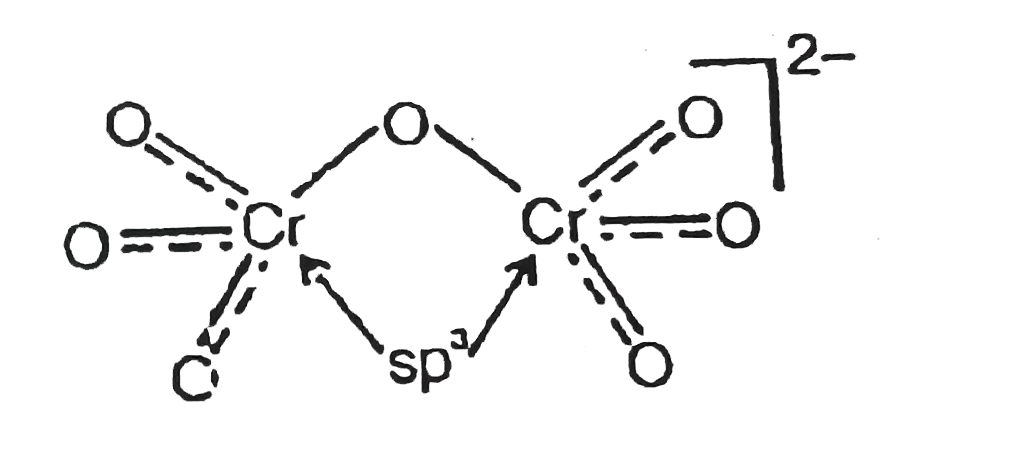 `Cr_2O_7^(2-)` has dimeric BRIDGED tetrahedral metal ion. The colour is DUE to charge transfer spectrum. (C )`NO_2^(-)` is being oxidised and `MnO_4^-` being reduced according to the following reaction. So it is redox reaction. , `2MnO_4^(-)+5NO_2^(-)+6H^(+)to2Mn^(2+)+5NO_3^(-)+3H_2O` 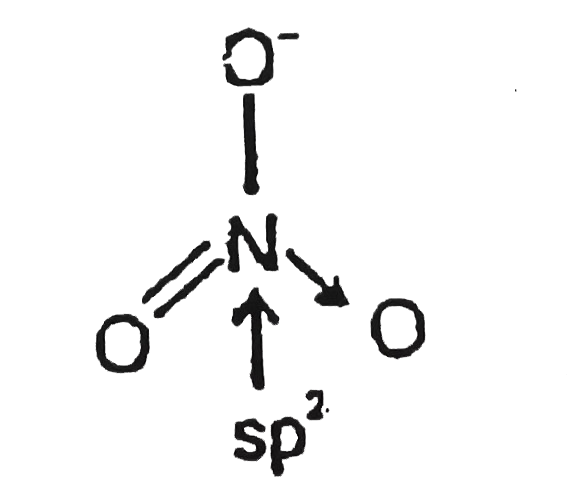 (D)`Fe^(2+)` is being oxidised and `NO_3^-` being reduced according to the following reaction. So it is redox reaction, `3Fe^(2+)+NO_3^(-)+4H^(+)toNO^(+)+3Fe^(3+)+2H_2O` `Fe^(2+)+NO^(+)+5H_2Oto [Fe(H_2O)_6NO]^(2+)` (brown ring) The colour is due to charge transfer spectrum. |
|