

Saved Bookmarks
| 1. |
[Ni(NH_(3))_(2)]^(2+)overset(Conc.HCl)(to)A+B The molecular formula of both A and B is same.A can be converted to B by boiling in dil. HCl. A on reaction with oxalic acid yields a complex having the formula Ni(NH_(3))_(2)(C_(2)O_(4)) but B does not. From the above information we can say that |
|
Answer» A is square planar but B is tetrahedral In this complex the oxidation state of Ni is +2  In complex `[Ni(NH_3)_2Cl_2],dsp^2` 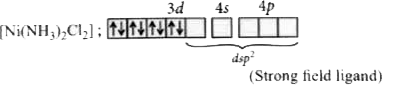 THUS the complex is square planar The two isomers of this complex are 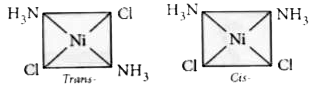 The cis isomer can easily form a chelate ring with oxalate group. The cis -ismers can be converted to trans isomer on boiling with dil HCl. Hence A is cis -isomer and B is trans -isomers. |
|