

Saved Bookmarks
| 1. |
Obtain an expression for potential energy due to a collectrion of three point charges which are separated by finite distances. |
|
Answer» Solution :Electrostatic potential energy for collection of point charges : The electric potential at a point at a distance r from charge `q_(1)` is given by `V=(1)/(4piepsilon_(0)) (q_(1))/(r )` This potential V is the work done to bring a unit POSITIVE charge from infinity at a distance r from `q_(1)` the work done is the product of `q_(2)` and the electric potential at that point. THUS we have `W = q_(2) V ` This work done is STORED as the electrostatic potential energy U of a system of charge `q_(1)` and `q_(2)` separated by a distance r. Thus we have `U=q_(2)V=(1)/(4piepsilon_(0))(q_(1))/(q_(2))/(r)` The electrostatic potential energy depends only on the distance between the two point charges . In fact the expression (3) is derived by assuming that `q_(1)` is fixed and `q_(2)` is brought from infinity. The equation (3) holds true when `q_(2)` is fixed and `q_(1)` is brought from infinity or both `q_(1)` and `q_(2)` are simultaneously brought from infinity to a distance r between them . Three charges are arranged in the following configuration as shown in Figure . To calculate the total electrostatic potential energy we use the following procedure . We bring all the charges one by one and arrange them according to the configuration . 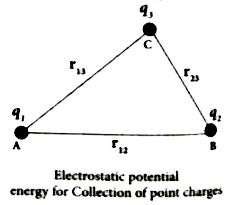 (i) Bringing a charge `q_(1)` from infinity to the point A requires no work because there are no other charges already present in the vicinity of charge `q_(1)` . (ii) To bring the second charge `q_(2)` to the point B work MUST be done against the electric field created by the charge `q_(1)` . So the work done on the charge `q_(2)` is W=` q_(2) V_(1B).` Here `V_(1B)` is the electrostatic potential due to the charge `q_(1)` at point B. `U=(1)/(4piepsilon_(0))(q_(2)q_(2))/(r_(12))` NOTE that the expression is same when `q_(2)` is brought first and then `q_(1)` later. (iii) Similarly to bring the charge `q_(3)` to the point C work has to be done against the total electric field due to both charges `q_(1)` and `q_(2)` . So the work done to bring the charge `q_(3)` is =` q_(3)(V_(1C)+V_(2C)).` Here `V_(1C)` is the electrostatic potential due to charge `q_(1)` at point C and `V_(2c)` is the electrostatic potential due to charge `q_(2)` at point C . The electrostatic potential is `U= (1)/(4piepsilon_(0))((q_(1)q_(3))/(r_(13))+(q_(2)q_(3))/(r_(23)))` (iv) Ading equations (4) and (5) the total electrostaic potential for the system of three charges `q_(1), q_(2)` and `q_(3)` is `U=(1)/(4piepsilon_(0))((q_(1)q_(2))/(r_(12))+(q_(1)q_(3))/(r_(13))+(q_(2)q_(3))/(r_(23)))` Note that this stored potential energy U is equal to the total external work done to asemble the three charges at the given locations . The epression (6) is same if the charges are brought to their poitions in any other order. Since the Coulomb force is a conservative force the electrostatic potential energy is independent of the manner in which the configuration of charges is arrived at . |
|