

Saved Bookmarks
| 1. |
Obtain Gauss'Law for magnetism and explain it. |
|
Answer» Solution :(1) According to Gauss's law for magnetism, the net magnetic flux `(phi_(B))` through any closed surface is always zero. (2) The law implies that the no. of magnetic FIELD lines LEAVING any closed surface is always equal to the number of magnetic field lines entering it. (3) Suppose a closed surface S is held in a uniform magnetic field B. Consider a SMALL vector area element `Delta S` of this surface as SHOWN in figure. (4) Magnetic flux through this area element is defined as `Delta phi_(B) = B. Delta S`. Then the net flux `phi_(B)`, is, `phi_(B) = UNDERSET("all")sum Delta phi_(B) = underset("all")(sum)B. Delta S = 0`. (5) If the area elements are really small, we can rewrite this equation as `phi_(B) = oint B. ds = 0` - (1) (6) Comparing this equation with Gauss's law of electrostatics i.e., electric flux through a closed surface S is given by `phi_(E) = oint E. Delta S = (q)/(epsilon_(0))` - (II) Where q is the electric enclosed by the surface. (7) In an electric dipole were enclosed by the surface equal and opposite charges in the dipole add upto zero. Therefore, `phi_(E)` would be zero. (8) The fact that `phi_(B) = 0` indicates that the simplest magnetic element is a dipole or current loop. (9) The isolated magnetic poles, called magnetic monopoles are not known to exist. (10) All magnetic phenomena can be explained interms of an arrangement of magnetic dipoles and/or current loops. (11) Thus corresponding to equation (II) of Gauss's theorem in electrostatics, we can visualize equation (I) as `phi_(B) = underset(S)intB.dS = mu_(0) (m) + mu_(0) (-m) = 0` where m is strength of N - pole and -m is strength of S - pole of same magnet. (12) The net magnetic flux through any closed surface is zero. 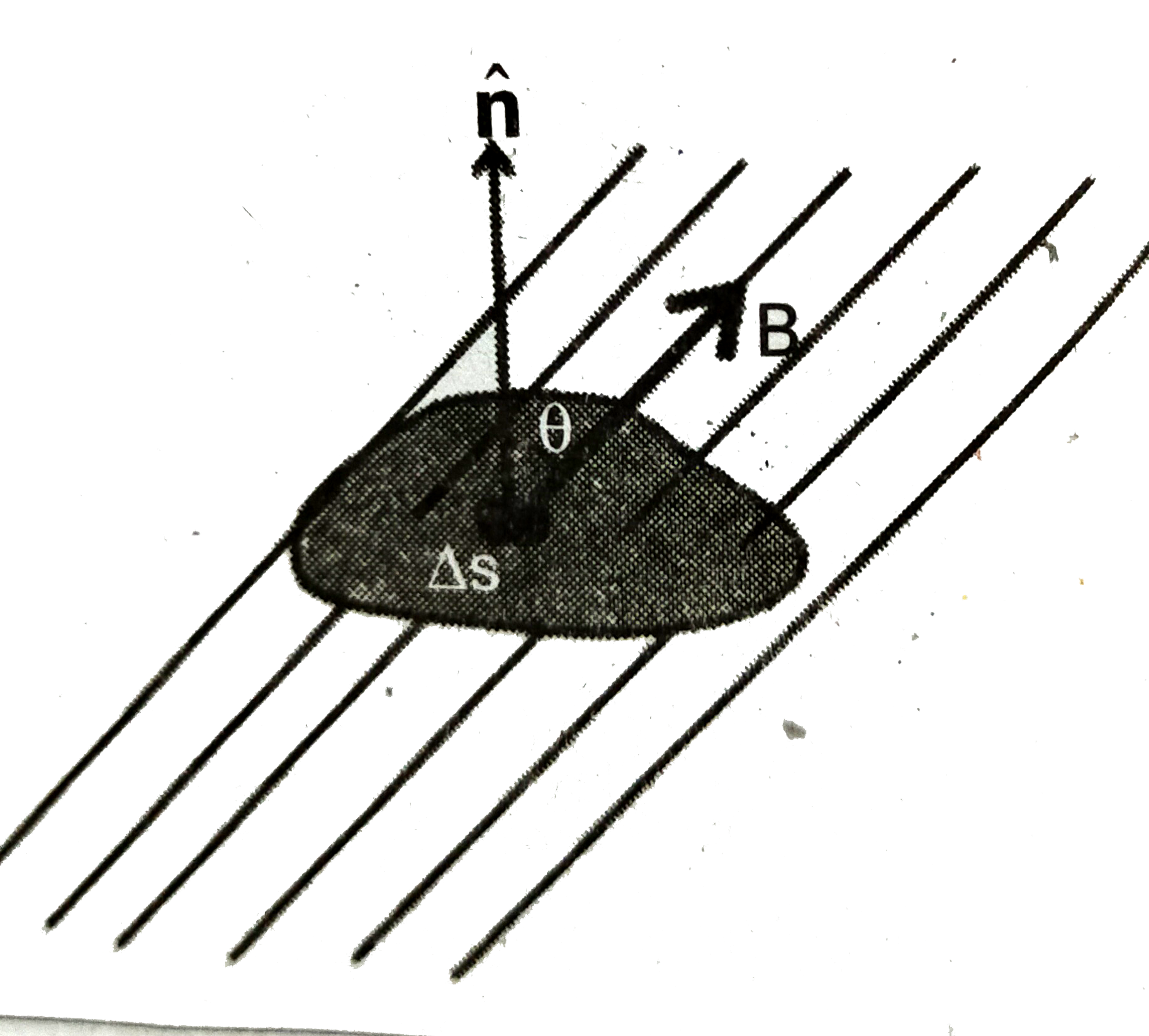
|
|