

Saved Bookmarks
| 1. |
Obtain the equivalent capacitance of the network in Fig. For a 300 V supply, determine the charge and voltage across each100 pFcapacitor. |
|
Answer» Solution :The arrangement is redrawn in FIG. Here `C_2 and C_3` are in series, hence their combinaed CAPACITANCE C. will be `C. = (C_2C_3)/(C_2 + C_3) = (200 xx 200)/(200 + 200) pF = 100 pF` Now this combination C. is in parallel arrangement to `C_1`, hence their combined capacitance `C..=C. + C_1 = 100 + 100 pF = 200pF` Finally C" is in series with `C_4`, hence resultant capacitance C will be `C=(C..C_4)/(C.. + C_4) = (200 xx 100)/(200 + 100) pF = 200/3 pF` `:.` TOTAL charge on whole arrangement `Q = CV = 200/3 pF xx 300V` `=2 xx 10^4 pC= 2 xx 10^(-8) C` `:.` Charge on combination C.. = Charge on `C_4 = 2xx 10^(-8)C` If potential difference ACROSS C.. and `C_4` be V.. and `V_4` respectively, then `V.. + V_4 = 300 V and (V..)/V_4 = C_4/(C..) = (100 pF)/(200 pF) = 1/2` `rArr V.. = 100 V and V_4 = 200 V` In the arrangement C.., `C_1` and C. are in parallel, hence `V_1 = V. = V.. = 100V` `:. Q_1= C_1 V_1= 100 pF xx 100V = 10^4 pC = 10^(-8) C` As in the arrangement C., capacitors `C_2 and C_3` are connected in series and `C_2 = C_3`, hence `V_2 = V_3 = (V.)/2 = (100V)/2 = 50V` `:. Q_2 = Q_3 = C.V. = 100pF xx100V = 10^4 pC = 10^(-8)C` 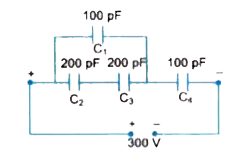
|
|