

Saved Bookmarks
| 1. |
Obtain the expression for the electric field at a point on the equatorial plane of an electric dipole. |
|
Answer» Solution :Consider an electric dipole CONSISTING of two point charges +q and -q separated by a small distance 2a. We have to find the electric FIELD intensity at p on the equatorial line of the dipole when `thetap=r`. `E_1` is electric field intensity at P due to charge +q is , `|E_1|=1/(4piepsilon_0)q/(AP^2)` where `AP^2=a^2+r^2` `|E_1|=1/(4piepsilon_0)q/(a^2+r^2)` The magnitudeof the electric field intensity at P due to charge -q is `|E_2|=1/(4piepsilon_0)q/(a^2+r^2)` The direction of `vecE_1` is away from the charge +q and the direction of `vecE_2` is towards the eachother charge -q as shown `vecE_1` and `vecE_2` can be RESOLVED into two components . The components normal to the dipole axis cancel away . The components along the dipole axis add up. `therefore vecE_1=(E_1 cos theta + E_2 cos theta )-hatP` Here the direction of `vecE` is opposite to the dipole monent P `therefore -hatP` is a unit vector . `vecE=(E_1+E_2)cos theta -hatP "" because |E_1|=|E_2|` `vecE=(1/(4piepsilon_0) q/((a^2+r^2)) + 1/(4piepsilon_0)q/((a^2+r^2))) cos theta -hatP` From the figure , cos `theta =1/((a^2+r^2)^(1//2))-hatP` `vecE=1/(4piepsilon_0)q/(a^2+r^2)[1+1]a/((a^2+r^2)^(1//2))-hatP` `=2 1/(4piepsilon_0)(qa)/((a^2+r^2)^(3//2))-hatP "" because P=qxx2a` `=1/(4piepsilon_0)P/((a^2+r^2)^(3//2))-hatP` `vecE=1/(4piepsilon_0)vecP/((a^2+r^2)^(3//2)) "" because hatP=vecP/P` a < << r So, a can be neglected . `vecE=1/(4piepsilon_0). vecP/((r^2)^(3//2))-vecP/P` `vecE=-1/(4piepsilon_0)vecP/r^3` 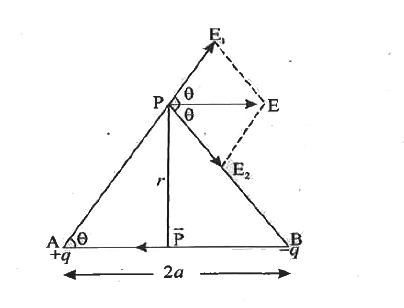
|
|