

Saved Bookmarks
| 1. |
Obtain the expression for the electric fieldat any point on the equatorial plane of an electric dipole. |
Answer» Solution :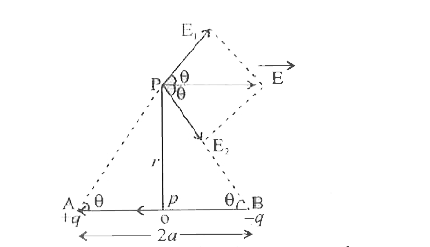 Consider an electric dipole consisting of two point charges +q and -q , separated by a small distance 2a. To find the electric field intensity at P on the equatorial line of the dipole . When OP=r, `E_l`the electric field intensityat P due to charge +q is `(E_1)=1/(4piepsilon_0)q/(AP^2) "" because AP^2 = a^2 + r^2` `(E_1)=1/(4piepsilon_0) q/(a^2+r^2)` The magnetic of the electric field intensity`E_2` at P due to charge -q is `(E_2)=1/(4piepsilon_0) q/(a^2+r^2)` The DIRECTIONOF `vecE_1` is away from the charge +q and the direction of `vecE_2` is TOWARDS the charge-q as shown . `vecE_1` and `vecE_2` can be resolved into two components . The components NORMAL to the dipole axiscancel away each other each being equal and opposite .The componentsalong the dipole axis add up. `therefore vecE_1=(E_1 cos theta + E_2 cos theta) - hatP` Here the directionof `vecE`is oppositeto dipole MOMENT P.`therefore -hatP` is unit vector. `vecE=(E_1+E_2)cos theta -hatP` From the figure , `cos theta = a/((r^2+a^2)^(1//2))` `vecE=[1/(4piepsilon_0)q/((a^2+r^2))+1/(4piepsilon_0) q/((a^2+r^2))]a/((a^2+r^2)^(1//2))-hatP` `vecE=1/(4piepsilon_0)q/((a^2+r^2)) [1+1] a/((a^2+r^2)^(1//2)) -hatP =1/(4piepsilon_0)(2qa)/((a^2+r^2)^(3//2))-hatP` `vecE=1/(4piepsilon_0)P((a^2+r^2)^(3//2))-hatP` P=q 2a `vecE=1/(4piepsilon_0)vecP/((a^2+r^2)^(3//2)) "" because hatP=vecP/P` As a < < < r , a can be neglected `vecE=1/(4piepsilon_0)vecP/((r^2)^(3//2))` `vecE=1/(4piepsilon_0)vecP/r^3` |
|