

Saved Bookmarks
| 1. |
Obtain the expressionfor the force betweentwo infinitely long straight parallelconductors carryingcurrent . Hencedefine"ampere" the SI unit of electric current. |
Answer» Solution :X and Y are two long straightparallelconductors carryingcurrents`I_1` and `I_2`respectively, and PLACED close to each other .d is the separationbetweenthe two conductorsand L is the lengthof the conductors. 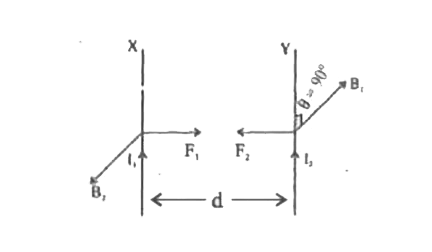 The magnetic fieldat any point on theconductorY dueto current`I_1` in the conductor X , is given by `B_1=(mu_0)/(4pi) (2I_1)/d`. `vecB_1` acts in adirectionperpendicularto the planecontainingthe two conductors . The conductorY whichforce due to `B_1` acting on it and this forceis given by `F_1 = B_1 I_2 L sin q`. `therefore F_1=(mu_0/(4pi) (2I_1)/d)I_2L sin theta` `F_1=mu_0/(4pi) (2I_1 I_2)/d L`...(1) Accordingto Fleming.s left hand rule , thedirectionof the force `F_1` on X is perpendicularto `B_2` and is towardsthe conductorY. The magneticfieldat any pointon theconductorX due tothe current`I_2` in y ,is given by `B_2=mu_0/(4pi)(2I_2)/d. vecB_2` acts on X and oppositeto `B_1` . The mechanicalforce actson X due to`B_2` is `I_1 L sin q.` `therefore F_2=(mu_0/(4pi)(2I_2)/d)I_2 L sin 90^@` `F_1=mu_0/(4pi) (2I_1I_2)d L` ....(2) Accordingto Flemings left hand side rule ,the directionof the force `F_2` on X isperpendicularto X and it is towardsthe conductory if the current`I_1` is inwards (oraway fromthe conductorY if the current`I_1` isoutwards). The force `F_1` actingon a certainlength of theconductorY due to the CURRENTIN the conductorX is equal in magnitudeto the force`F_2` actingon the same length of X due to the currentinconductorY. If the two conductors carry the currents in the same direction (parallelcurrents ) then the forcesattract each other . If the two conductorscarry the currentsin the oppositedirections (anti-parallel currents ), thenthey are foundto repel each otherbecausethe two forcesact awayfrom each other. The force per unit lengthon each conductoris `F_L=F_1 /L=F_2/L=(mu_0/(4pi)(2I_1I_2)/d L)/L` i.e., `F_L=mu_0/(4pi)(2I_1I_2)/d` One ampere of currentcan be defined as thatconstantcurrentwhich when maintainedthrougheach of the two infinitelylong staightparallelconductorsof negligiblearea of crosssection in the same directionplaced 1 metreapart in VACUUM,causesan attractiveforce of2. `10^(-7) N m^(-1)`lengthon eachconductor . |
|