

Saved Bookmarks
| 1. |
Obtain the relation between electric field and electric potential due to a point charge. |
Answer» Solution :Consider a point charge .+q.. Let .P. be a point initially at INFINITY. Let .A. be a point inside the field region. Let.+1C. be a unit POSITIVE charge moved from the point at infinity to point .A.. Let .A. be at a distance of .r from the given point charge. Let .B. be another point at distance of dr.. from .A. towards the point charge +q. 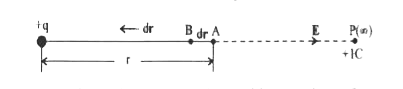 The work done in MOVING positive test charge from A to B, against the force of repulsion is dW= Fdr. The-ve sign indicates that the work is done against the direction of the force and dr is the displacement of +1 C Of test charge in the direction opposite to the electric field. But electric potential `dV=(dW)/(+q_0)` and electric field`E=E/(+q_0)` When `q_0`=+1C thendW=dV, E=F Hence dV=-Edr or `E=-(dV)/(dr)` i.e., Electric field intensity at a point is the negative potential gradient at that point and electric field intensity is in the direction of DECREASING ELECTROSTATIC potential. |
|