

Saved Bookmarks
| 1. |
ODBAC is fixed rectangular conductor of negligible resistance (CO is not conneted) and OP is a counductor which rotates clockwise with an angular velocity omega Fig. The entrie system is in a uniform magnetic field B whose direction in along the normal to the surface of the rectangular conductor ABDC. The conductor OP is in electric contact with ABDC. The rotating conductor has a resistance of gamma per unit length. Find the current in the rotating conductor, as it rotates by 180^(@) |
|
Answer» Solution :The SET up is shon in Fig Between time t = 0 `t = (T)/(8) = (pi)/(4 omega)`, the rod OP will make contach with side BD. At any time t: `0 lt t lt (pi)/(4 omega)`, let the length `:.` Magnetic flux through the area ODQ is `phi = B xx area OQD = B xx (1)/(2) QD xx OD = B xx (1)/(2) l tan theta xx l` 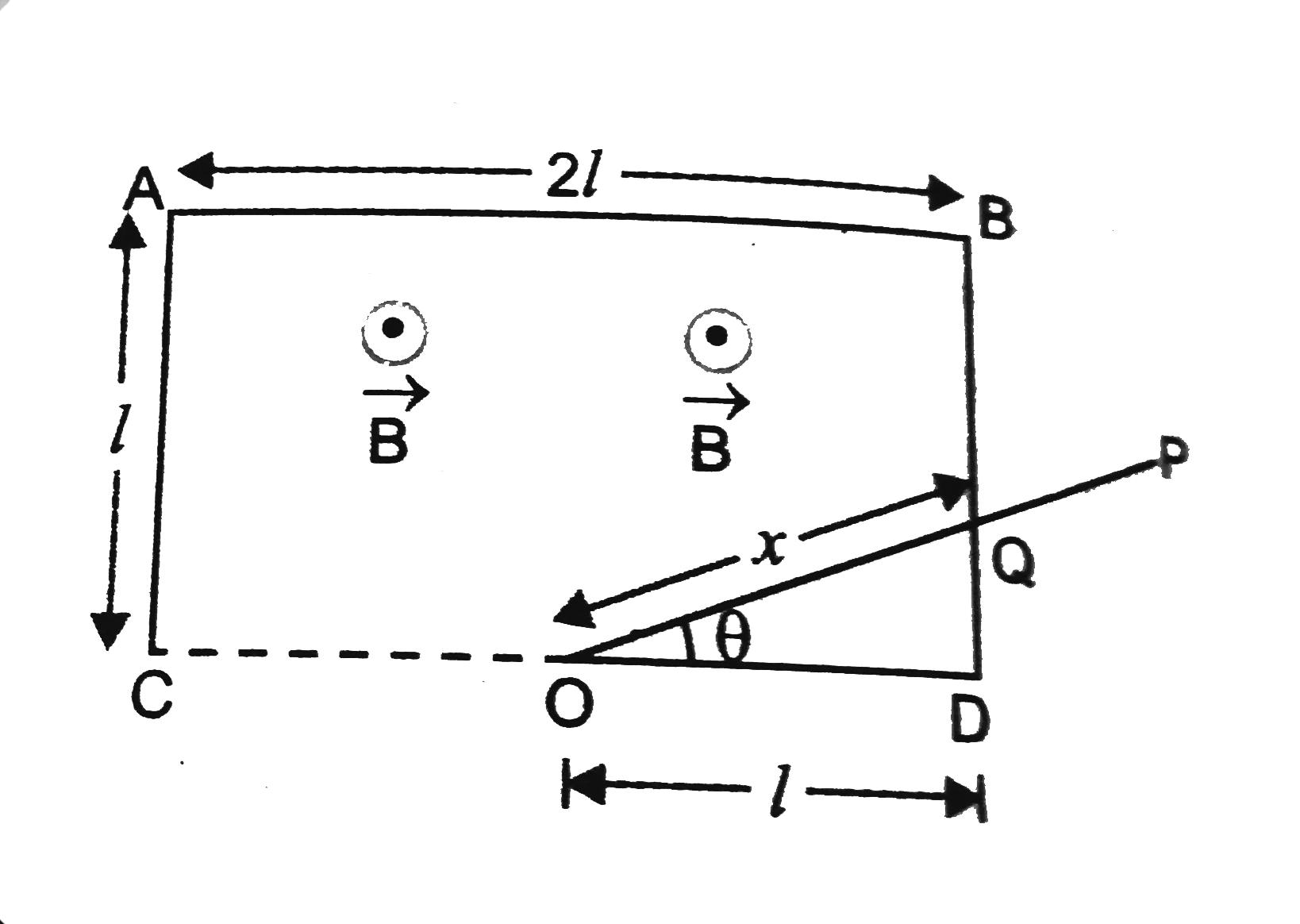 `phi = (1)/(2) B l^(2) tan theta`, where `theta = omega t` Magnetic of EMF generated, `e = (d phi)/(dt) = (1)/(2) B l^(2) omega sec^(2) omega t` If R is resistance of the rod in contact, then induced current `I = (e)/(R )`. Now , `R = lambda x = (lambda l)/(cos omega t):. I = (1)/(2) (B l^(2) omega sec^(2) omega t)/(lambda l //cos omega t) = (B l omega)/(2 lambda cos omega t)` For `t = (T)/(8) = (pi)/(4 omega )` to `t = (3T)/(8) = (3 pi)/(8)`, the rod is contact with the side AB, as shown in Fig. Let the length of the rod in contant, OQ = x. Magnetic flux linked with area ODBQ `phi = B xx `area of TRAPEZIUM ODBQ `= B(l^(2) - (l^(2))/(2 tan theta))`, where `theta = omega t` 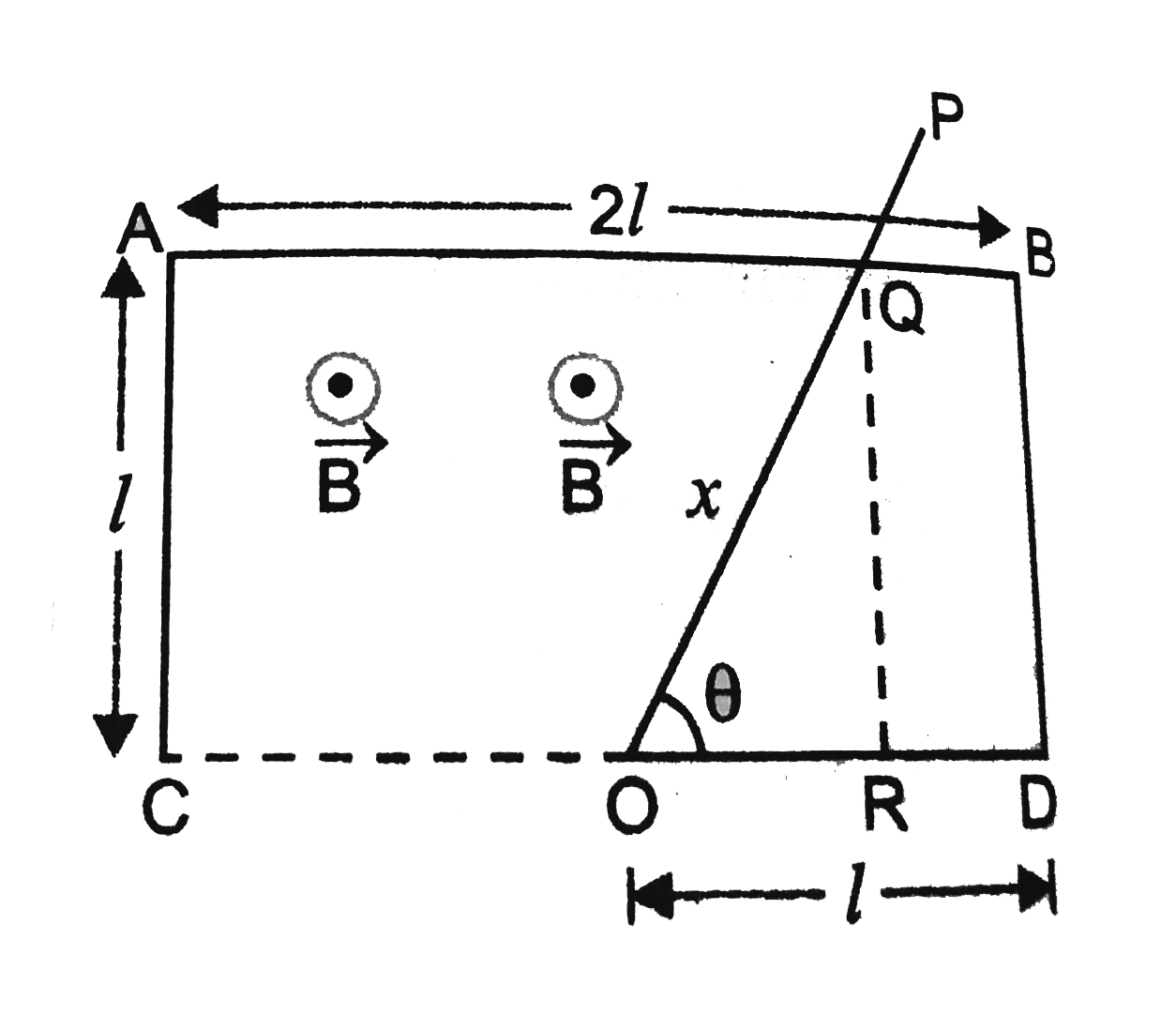 Magnitude of emf generated, `e = (d phi)/(dt) = (1)/(2) B l^(2) omega sec^(2) omega t = (1)/(2) B l^(2) omega (sec^(2) omega t)/(tan^(2) omega t)` Induced current, `I = (e)/(R ) = (e)/(lambda x) = (e sin omega t)/(lambda l) = (1)/(2 lambda) xx (B l omega)/(sin omega t)` For `t = (3T)/(8) = (3 pi)/(4 omega)` to `t = (4 T)/( 8) = (pi)/(omega)`, the rod is in contact with the side AC as shown in Fig. Let the length of the rod in contact OQ = x. Magnetic flux linked with area ODBAQ `phi = B xx` [area of rectangular ABDC - area of `Delta OQC`] 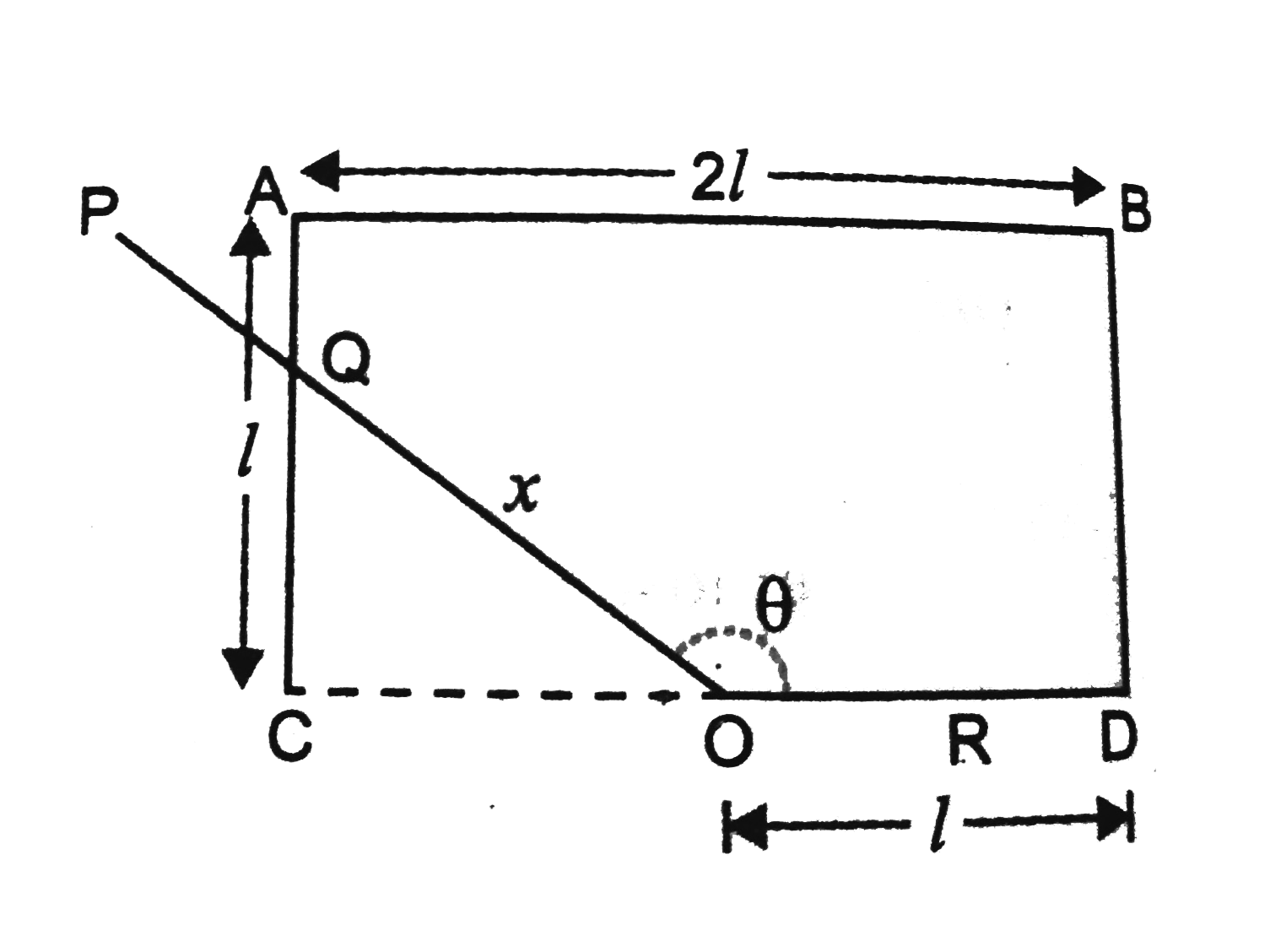 `phi = B [2 l^(2) - (l^(2))/(2 tan omega t)]` Magnitude of induced emf, `e = (d phi)/(dt) = (d)/(dt) B (2 l^(2)- (l^(2))/(2 tan omega t)) = (B omega l^(2) sec^(2) omega t)/(2 tan^(2) omega t)` Induced current, `I = (e)/(R ) = (e)/(lambda x) = (e sin omega t)/(lambda l) = (B l omega)/(2 lambda sin omega t)` |
|