

Saved Bookmarks
| 1. |
On the basis of your understanding of the following paragraphand the related studied concepts. An equipotential surface is a surface with a constant value of electric potential at all points on the surface. The component of electric field parallel to an equipotential surface is zero, as the potential does not change in this direction. Thus, the electric field is perpendicular to the equipotential surface at each point of the surface. Further, say the direction of electric field electrical potential gradually fall with distance. If electric potential at origin point O be 100 V, then for electric field specified in part (b), draw equipotential surfaces corresponding to potentials 80 V, 60 V and 40 V respectively. |
|
Answer» Solution :As `E = 1000 hatiV m^(-1)`, so distance Ar between points having potentials `V_0 = 100 V and V_1 = 80 V` is `Delta r = (x_1 = 0) = (V_0-V_1)/E = (100-80)/(1000)` `= 0.02m = 2.0m` `rArr x_1 = 2.0 m` Similarly potential `V_2= 60 V and V_3 = 40 V` corresponds to POSITIONS `x_2 = 4.0 cm and x_3 = 6.0 cm` respectively. Equipotential surfaces CORRESPONDING to these potentials are drawn here. 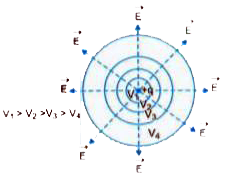
|
|