

Saved Bookmarks
| 1. |
Out of C_(6)H_(5)CH_(2)Cl and C_(6)H_(5)CHClC_(6)H_(5) which is more easily hydrolysed by aqueous KOH? |
Answer» Solution :`C_(6)H_(5)CH_(2)Cl` is a `1^(@)` aralkyl HALIDE while `C_(6)H_(5)CH(Cl)C_(6)H_(5)` is a `2^(@)` aralkyl halide. 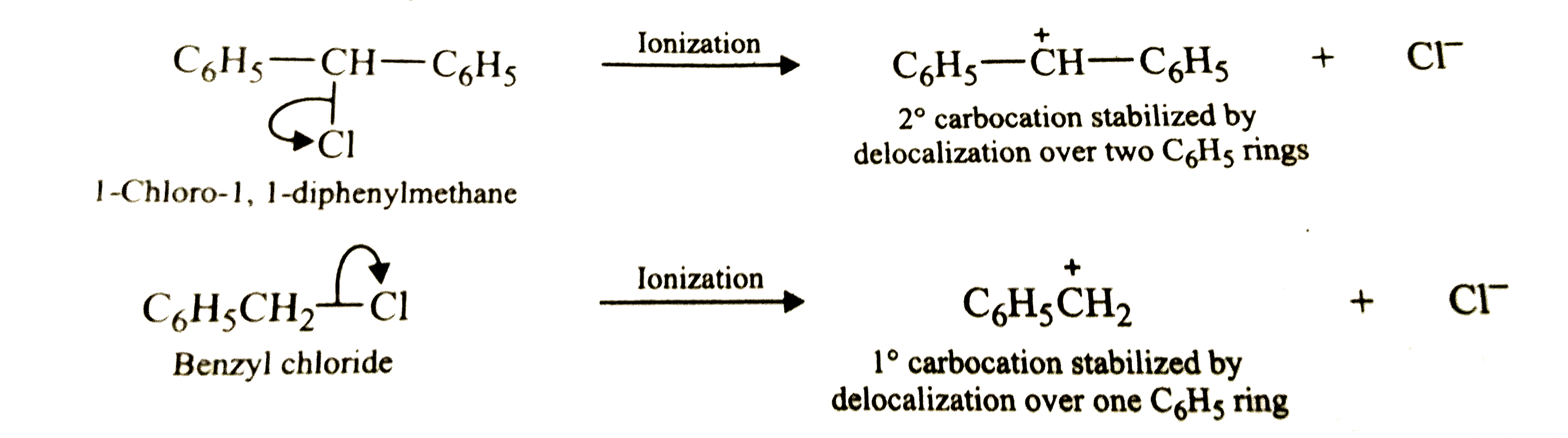 In `S_(N)1` reactions, the reactivity depends upon the stability of carbocations, SINCE the carbocation `C_(6)H_(5)overset(+)(C)HC_(6)H_(5)` (where the +ve charge is delocalised over the `C_(6)H_(5)` RINGS) DERIVED from `C_(6)H_(5)-CHCl-C_(6)H_(5)` is more stable than the carbocation, `C_(6)H_(5)CHClC_(6)H_(5)` gets hydrolysed more easily than `C_(6)H_(5)` ring) derived from `C_(6)H_(5)CH_(2)Cl`, therefore, `C_(6)H_(5)CHClC_(6)H_(5)` gets hydrolysed more easily than `C_(6)H_(5)CH_(2)Cl` under `S_(N)2` conditions. However, under `S_(N)2` conditions, the reactivity depends on STERIC hindrance, therefore, under `S_(N)2` conditions, `C_(6)H_(5)CH_(2)Cl` (with lesser steric hindrance) gets hydrlysed more easily than `C_(6)H_(5)CHClC_(6)H_(5)`. |
|