

Saved Bookmarks
| 1. |
Out of C and CO, which is a better reducing agent at 673K? |
|
Answer» Solution :Carbon reacts with oxygen in one of the following two ways : `{:(C(s)+O_(2)(g) to CO_(2)(s)"""..........."(i)),(2C(s)+O_(2)(g) to 2CO(g)"""..........."(ii)):}` The CO produced in (ii) can also react with `O_(2)` to form `CO_(2)` `2CO(g)+O_(2)(g) to 2CO_(2)(g)""".........."(iii)` In the first REACTION, the volume of `CO_(2)` produced is almost the same as that of `O_(2)` used, therefore, `triangleS` is very small and `triangleG^(0)` does not change with temperature. Thus, the graph of `triangleG^(0)` against T is almost horizontal (see the figure). The second reaction produces two VOLUMES of CO for EVERY one volume of `O_(2)` used. Thus, `triangleS` is positive and hence `triangleG^(0)` becomes increasingly negative as the temperature increases. `triangleG= triangleH- T triangleS`. Consequently, its line on the Ellingham diagram slopes downwards. The third reaction produces two volumes of `CO_(2)` for every three volumes of reactants used. Thus, `triangleS` is `-ve` and hence `triangleG^(0)` becomes increases. Consequently, its line on the Ellingham diagram slops upwards. The three lines cross at 673K (see Fig. 6.3). Below this temperature, formation of `CO_(2)` is energetically more favourable and above this temperature, formation of CO is energetically more favourable. In other words, below 673 K, both C and CO can act as reducing agents but SINCE CO can be more easily oxidised to `CO_(2)` than C to `CO_(2)`, therefore, below 673 K, CO is a more effective reducing agent than C. Above 673 K, `triangleG` vs T curve for `CO to CO_(2)` lies above the corresponding curves for both `C to CO_(2)" and "C to CO`, therefore C is a better reducing agent than CO. 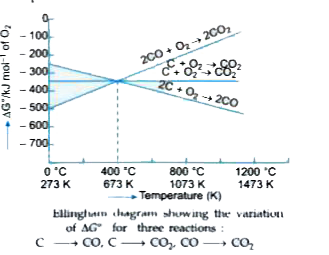
|
|