

Saved Bookmarks
| 1. |
Out of CH_(3)-underset(CH_(3))underset(|)(C)H-CH_(2)-Cl and CH_(3)-CH_(2)-underset(CH_(3))underset(|)(C)H-Cl which is more reactive towards S_(N)1 reaction and why? |
Answer» Solution :Reactivity in `S_(N)1` reactions DEPENDS upon the stability of the carbocation it gives on ionization. Now, the first COMPOUND, i.e., 1-chloro-2-methylpropane gives a `1^(@)` carbocation and the second compound, i.e., 2-chlorobutane gives a `2^(@)` carbocation. 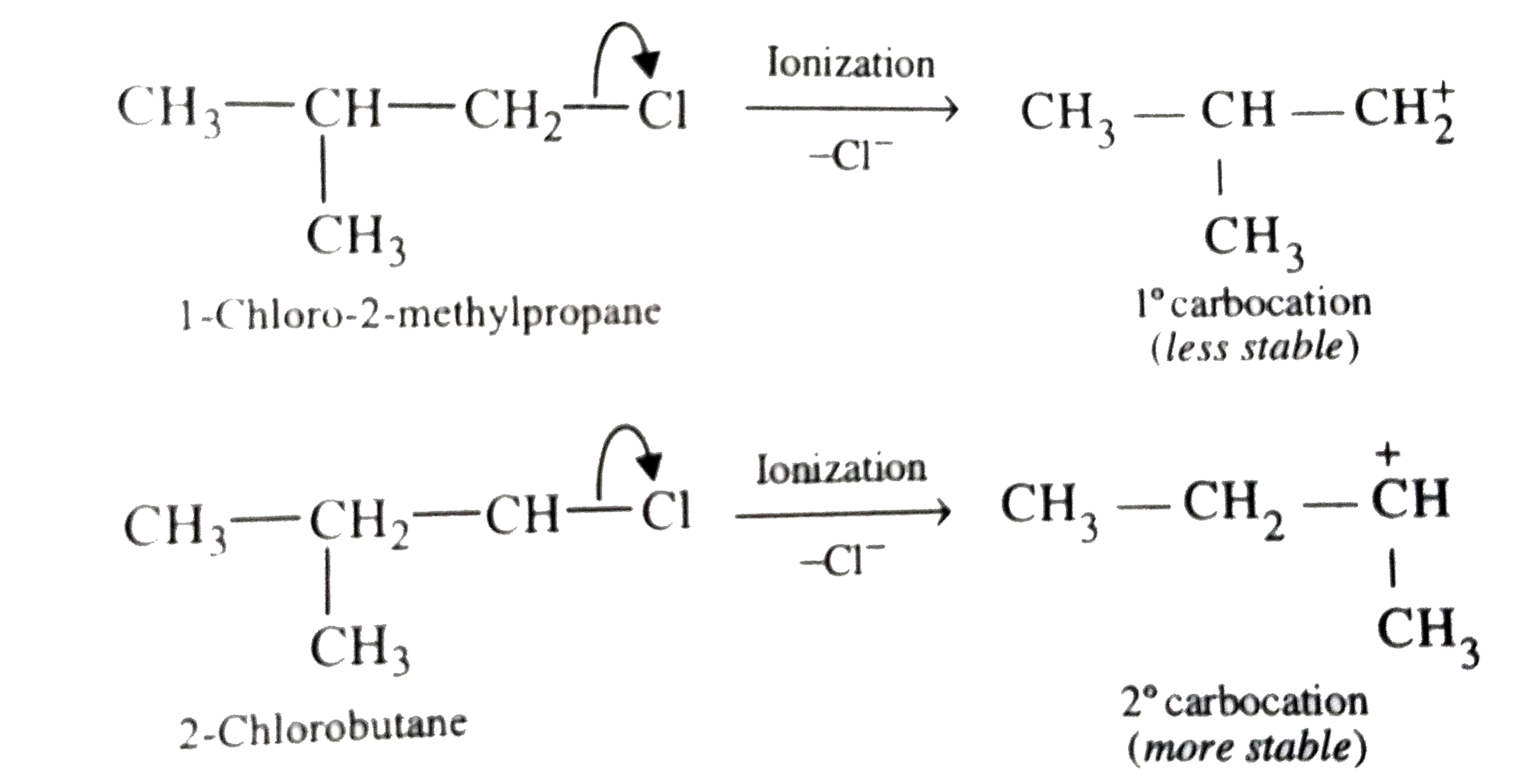 SINCE `2^(@)` carbocations are more stable than `1^(@)` carbocations, therefore, second compound, i.e., 2-chlorobutane reacts faster than the first compound, i.e., 1-chloro-2-methylpropane. Alternatively, first compound, i.e., 1-chloro-2methylbutane is a `1^(@)` alkyl halide while the second compound, i.e., 2-chlorobutane is a `2^(@)` alkyl halide. since in `S_(N)1` reactions, `2^(@)` alkyl halides are more reactive than `1^(@)` alkyl halides, therefore, second compound, i.e., 2-chlorobutane reacts faster than the first compound, i.e., 1-chloro-2-methylpropane. |
|