

Saved Bookmarks
| 1. |
Outline the path-breaking experiments of Faraday and Henry and highlight the contributions of these experiments to our understanding of electromagnetism. |
|
Answer» Solution :Faraday's and Henry's experiments: Experiment 1 : A magnet induces due to relative motion due to relative motion (i) The apparatus consists of a coil with a galvanometer G and a bar magnet. (ii) When the bar magnet (NS) was at rest, the galvanometer shows no deflection. (iii) When North pole of the bar magnet MOVED towards the coil, galvanometer shows the deflection in one DIRECTION indicating the flow of current in the coil. (iv) When North pole of the bar magnet moved away from the coil, galvanometer again showed the deflection but now in the opposite direction. (v) The deflection of the galvanometer was large when the bar magnet was moved faster towards (or) away from the coil. (vi) When south pole of the magnet was brought near the coil (or) moved away from the coil the deflections in the galvanometer are opposite to that observed with the north pole for similar movements. Conclusion : (i)Whenever there is a relative motion between a coil and a magnet, induced current flows through the coil. (ii) Large induced e.m.f. (or) current is produced in the coil if the relative motion between magnet and the coil is large. Experiment 2: Current induces current due to relative motion of coils : (i) The bar magnet is replaced by a secondary coil `C_2` connected to a bàttery as shown in figure. (ii) The steady current in the coil `C_2` produces a steady magnetic field. (iii) As coil `C_2` is moved towards the coil `C_1` the galvanometer shows a deflection. This indicates current is induced in the coil `C_(1)`. (iv) When coil `C_2` is moved away, the galvanometer shows a deflection again, but opposite direction. (v) The deflection lasts as long as coil `C_(2)` is in motion. vi) When the coil `C_2` is held fixed and `C_1` is moved, the same effects are observed. Conclusion : Induced e.m.f (or) current is produced, when there is a relative motion between the coils. Experiment 3 : Changing current, induces current without relative motion : (i) Faraday showed that this relative motion is not an absolute requirement. (ii) Figure shows two coils `C_1 and C_2` held stationary. (iii) Coil `C_1` is connected to a battery through a TAP key K and coil `C_2` is connected to a galvanometer (G). It is observed that the galvanometer shows a momentary deflection when the tap key K is pressed. 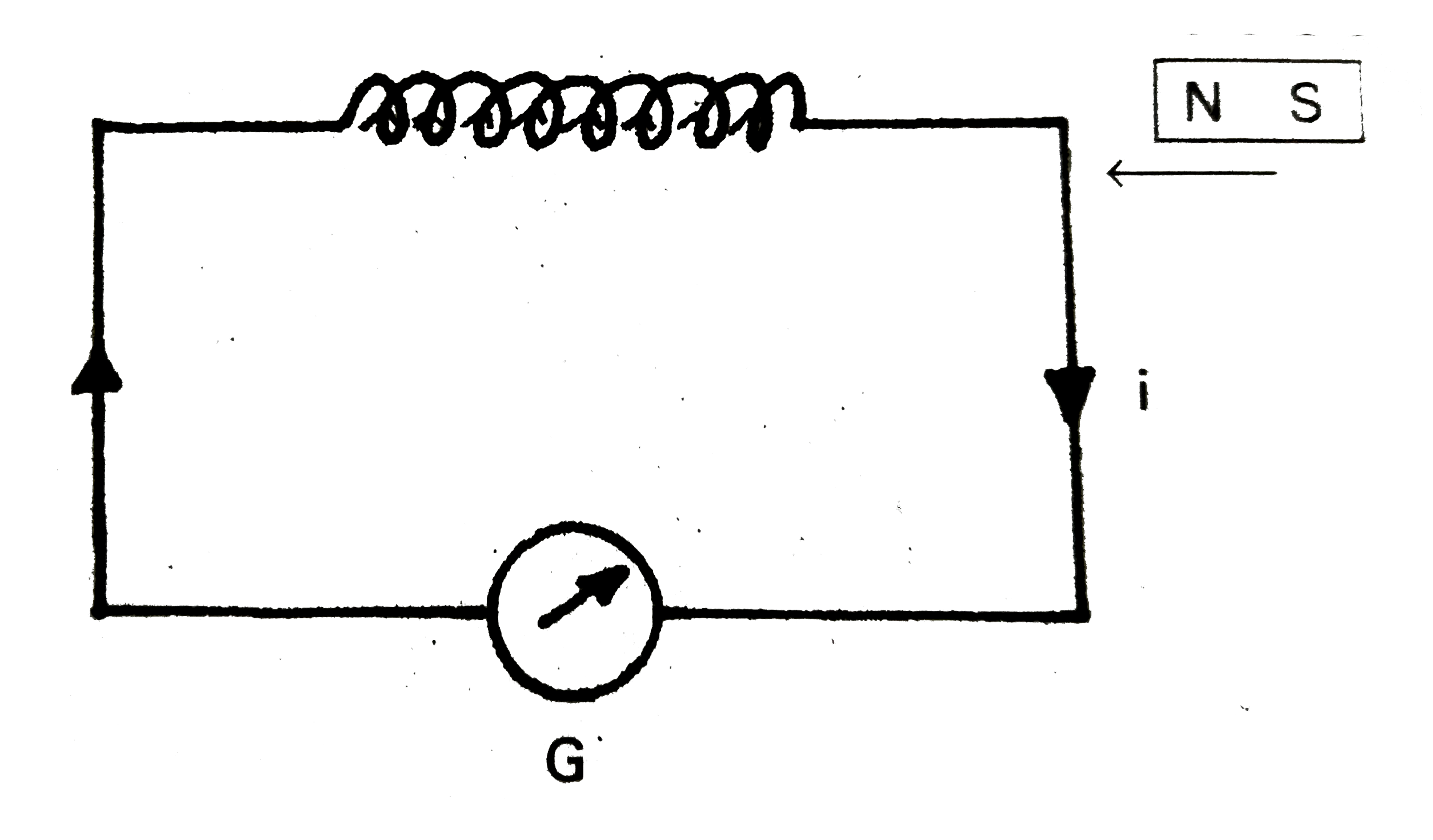 (v) The pointer in the gahanonter returns to ZERO immediately v the key is held pressed continoulsy, deftection in the galvanometer. (vii) When the key is released, the galvanmeter showe deflection again but in the opposite direction ltbfrgt (viii) Deflection of the galvanometer incresses IOT when wooden bar is replaced by iron bar. 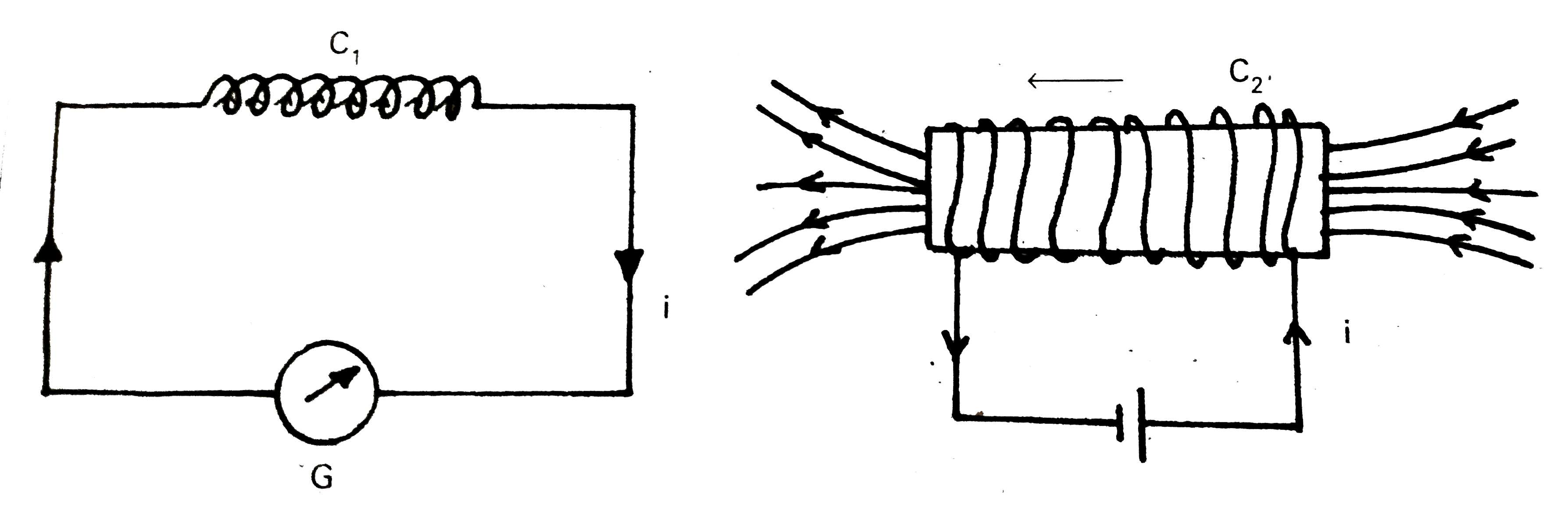 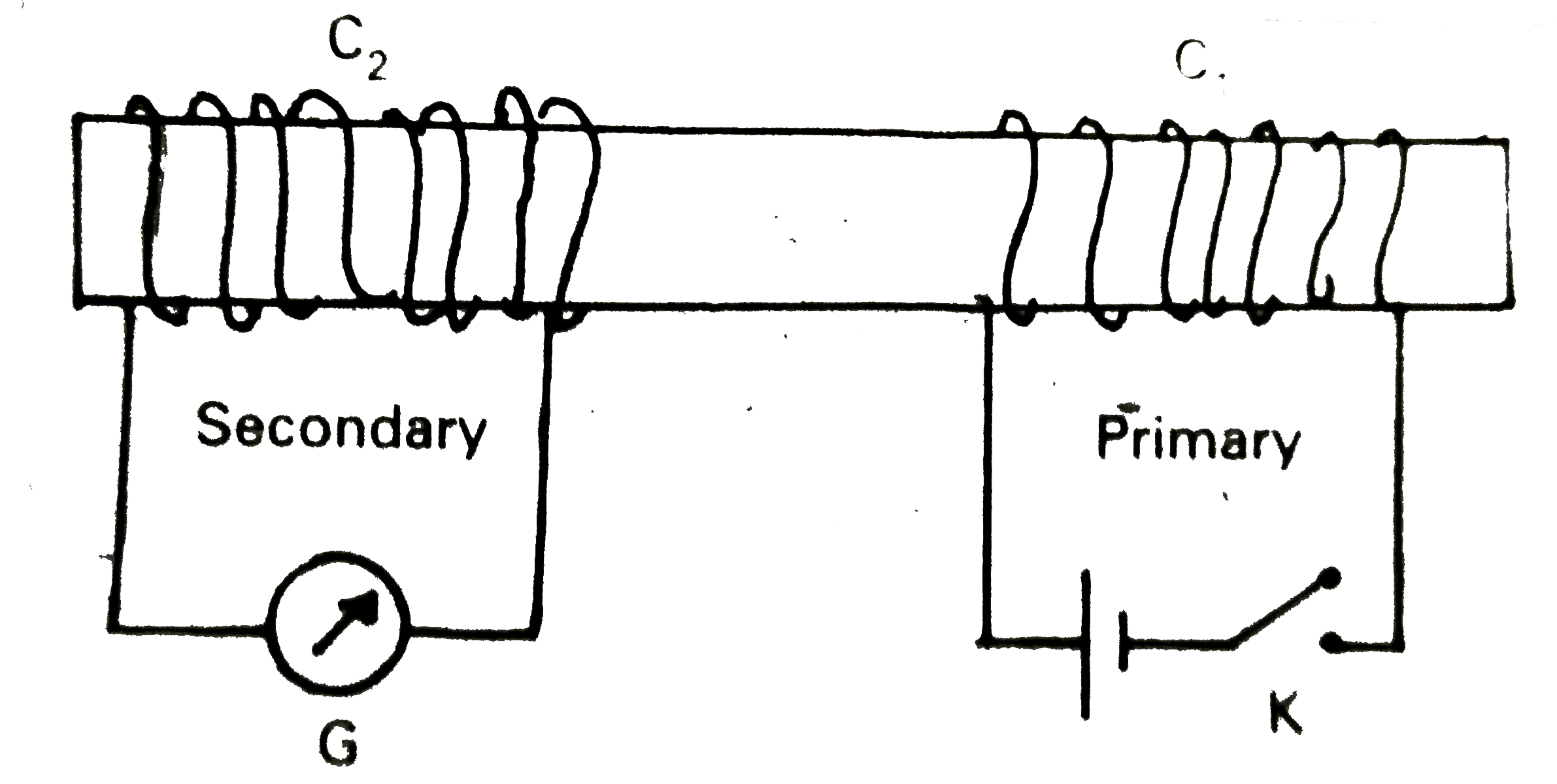
|
|