

Saved Bookmarks
| 1. |
Pipe A is open at both ends and has length L_A = 0.343 m. We want to place it near three other pipes in which standing waves have been set up, so that the sound can set up a standing wave in pipe A. Those other three pipes are each closed at one end and have lengths L_B = 0.500L_A,L_C = 0.250L_A and L_D = 2.00L. For each of these three pipes, which of their harmonics can excite a harmonic in pipe A? |
|
Answer» Solution : (1) The sound from one pipe can SET up a standing wave it another pipe only if the harmonic frequencies match. (2) Equation gives the harmonic frequencies in a pipe with two open ends (a symmetric pipe) as f = nv/2L, for n 1,2,3,..., that is, for any positive integer. (3) Equation 17-40 gives the harmonic frequencies in a pipe with only one open END (an asymmetric pipe) as f= nv/4L, for n = 1, 3, 5, ..., that is, for only odd positive integers. Pipe A: Let.s first FIND the resonant frequencies of symmetric pipe A (with two open ends) by evaluating Eq. `f_A = (n_Av)/(2L_A) = (n_A(343 m//s))/(2(0.434 m))` ` = n_A (500 Hz) = n_A (0.50 kHz) ," for" on_A = 1, 2 ,3 ,.......... ` The first six harmonic frequencies are shown in the top plot in Fig. Pipe B: Next let.s find the resonant frequencies of asymmetric pipe B (with only one open end) by evaluating Eq., being careful to use only odd integers for the harmonic numbers: ` f_B = (n_B v)/(4L_B) = (n_B v)/(4(0.500 L_A)) = (n_B (343 m//s))/(2(0.343 m))` `n_B (500 Hz) = n_B (0.500 kHz) ,"for" n_B = 1, 3, 5,.....` Comparing our two results, we see that we get a match for each choice of`n_B` : `f_A = f_B "for" n_A = n_B"with" n_B = 1,3,5 ............` For example, as shown in Fig. , if we set up the FIFTH harmonic in pipe B and bring the pipe close to pipe A,the fifth harmonic will then be set up in pipe A. HOWEVER, no harmonic in B can set up an even harmonic in A. Pipe C: Let.s continue with pipe C (with only one end) by writing Eq. as `f_C = (n_Cv)/(4L_C ) = (n_Cv)/(4(0.250L_A)) = (n_C (343 m//s))/(0.343 m//s)` `n_C (1000 Hz) = n_C (1.00 kHZ ),"for "n_C = 1,3,5,......` From this we see that C can excite some of the harmonics of A but only those with harmonic numbers n, that are twice an odd integer: `f_A = f_C "for" n_A = 2n_C ,"with"n_C = 1,3,5,.......` Pipe D: Finally, let.s check D with our same procedure: `f_v = (n_Dv)/(4L_D) = (n_D v)/(4(2L_A)) = (n_D (343 m//s))/(8(0.343 m//s))` ` = n_D (125 Hz) = n_D (0.125 kHz),"for" n_D = 1,3,5,.....` As shown in Fig., none of these frequencies match a harmonic frequency of A. (Can you see that we would get a match if `n_D = 4n_A`? But that is impossible because `4n_A` cannot yield an odd integer, as required of `n_D`.) Thus D cannot set up a standing wave in A. 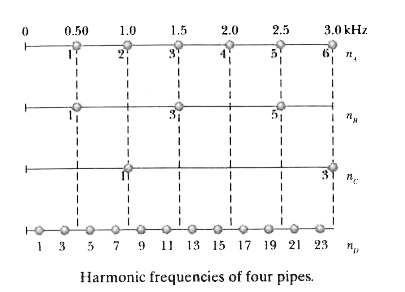
|
|