

Saved Bookmarks
| 1. |
Predict the order of reactivity of the folloiwingcompoundss in SN^(1) and SN^(2) reacations. a.The four isomeric bromolbutanes b. I. C_(6)H_(5)CH_(2)Br II. C_(6)H_(5) CH (C_(6) H_(5)) Br III. C_(6)H_(5)CH (CH_(3) Br IV. C_(6)H_(5)C(CH_(3)(C_(6) H_(5)) Br |
Answer» SOLUTION :a. 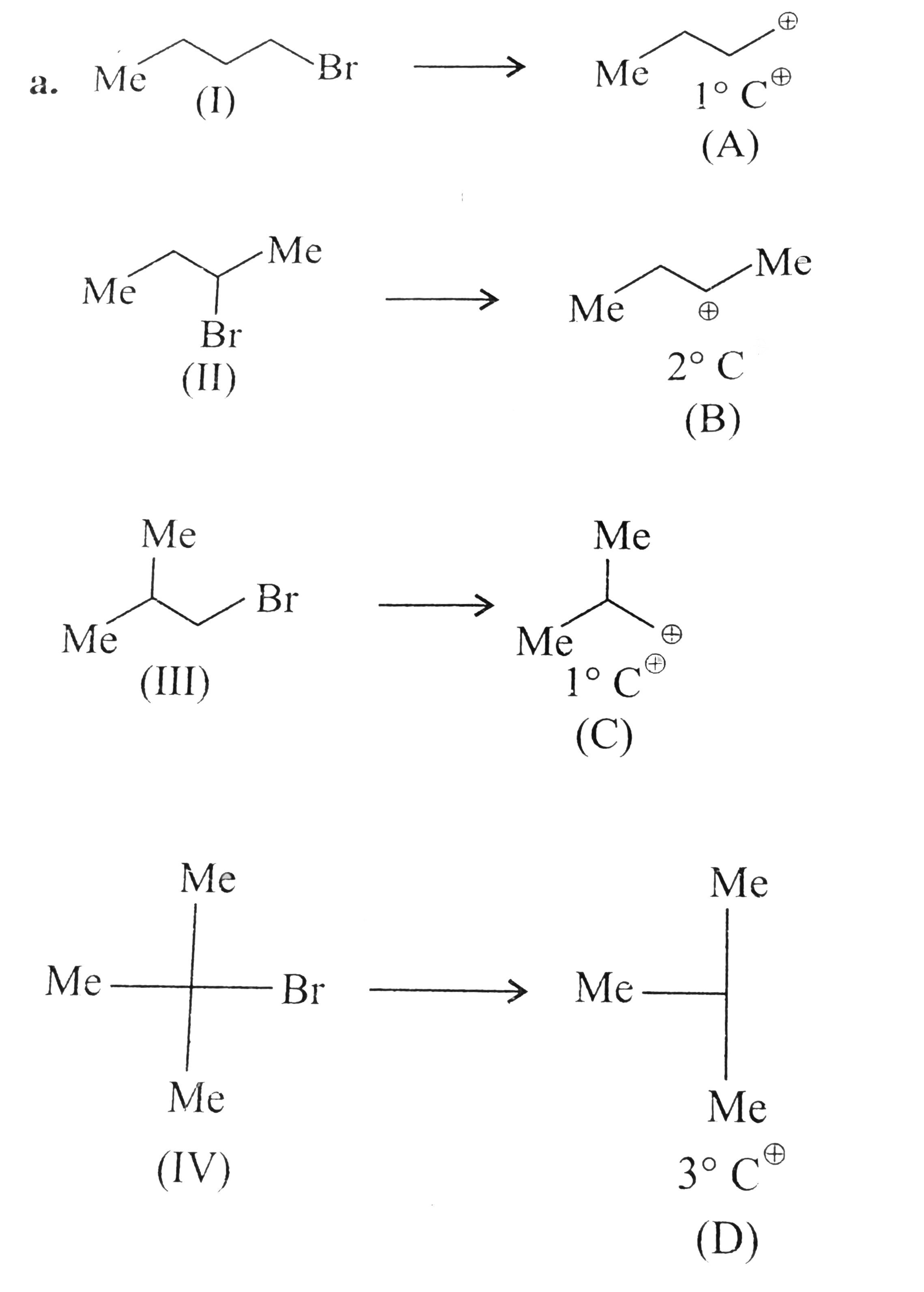 Out of `1^(@) C^(o+) (A)` and `(C),(C)` is more stable due to `+I` effect of TWO `(Me)` groups. Therefore, `(III)` is more reactive than `(I)` in `SN^(1)` reaction. `SN^(1) implies )I) gt (III) gt (II) gt (IV)` `SN^(2) implies (I) gt (III) gt (II) gt (IV)` b. `SN^(1) implies C_(6) H_(5) C(CH_(3)) (C_(6)H_(5))Br (IV)` `gt C_(6) H_(5) CH (C_(96) H_(5)) - Br gt C_(6) H_(5) CH(CH_(3)) Br gt C_(6) H_(5) CH_(2)Br` `gt (II) gt (III) gt (I)` `SN^(2) implies C_(6)H_(5)C(CH_(3))(C_(6)H_(5))Br lt C_(6) H_(5) CH(C_(6) H_(5)()-Br lt` `(IV) lt (II)` `C_(6)H_(5)CH(CH_(3))Br lt C_(6)H_(5)H_(2)Br` `(III) lt (I)` Of the two secondary bromides, the carbocation intermediate obtainedfrom `(II)` is more stable than thatobtained FORM`(III)` becuase it is stablised byu two phenyl groupsdue to resonacne. Therefore the foremer bormide is more reactive than the latter in `SN^(-1)` reacations. A phenyl group is bulkier than a methuyl group . THerefore `(II0` is less reactive than `(III)` in `SN^(2)` reacations. |
|