

Saved Bookmarks
| 1. |
Predict which of the following will be coloured in aqueous solution Ti^(2+), V^(3+), Se^(4+), Cu^(+), Sc^(3+), Fe^(3+), Ni^(2+), and Co^(3+) |
|
Answer» Solution :Among`Ti^(2+), V^(3+), Se^(4+), Cu^(+), Sc^(3+), Fe^(3+), Ni^(2+)`, and `Co^(3+)` in aqueous solution state, Ti (Z = 22) `Ti^(2+)` -Electronic configuration is `[AR] 3D^(2)` V (Z = 23) `V^(3+)` -Electronic configuration is `[Ar]3d^(2)` Sc (Z = 21)`Se^(4+)`-Electronic configuration is `[Ar] 1s^(2) 2s^(2) 2p^(6) 3s^(2) 3p^(5)` Cu (Z = 29) `Cu^(+)`-Electronic configuration is `[Ar] 3d^(10)` Sc (Z = 21) `Sc^(3+)`-Electronic configuration is `[Ar] 3d^(0)4s^(0)` Fe (Z = 26)`Fe^(3+)` Electronic configuration is `[Ar] 3d^(5)` Ni (Z = 28) `Ni^(2+)`-Electronic configuration is `[Ar] 3d^(6)` Co (Z = 27)`Co^(3+)`-Electronic configuration is `[Ar] 3d^(5)` A TRANSITION metal ion is coloured if it has one or more unpaired electrons in (n-1) d orbital. i.e. 3d orbitals in the case of first transition series, when such species are exposed to visible radiation, d-d transition take place and the species are coloured. 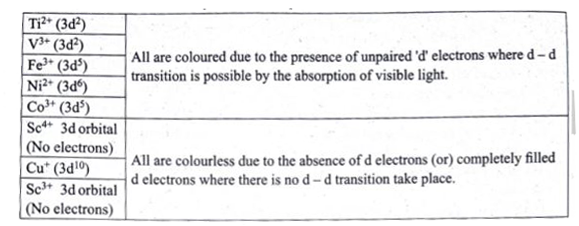
|
|