

Saved Bookmarks
| 1. |
Prove theoretically E=-(d Phi)/(dt). |
|
Answer» Solution :Consider a rectangular wire loop PQRS of width `l`, with its plane perpendicular to a uniform magnetic FIELD of induction `vecB`. The loop is being pulled out of the magnetic field at a constant speed v, as shown. At any instant,let x be the length of the part of the loop in the magnetic field. Then, the magnetic flux through the loop is `Phi=Blx ""` ...(1) 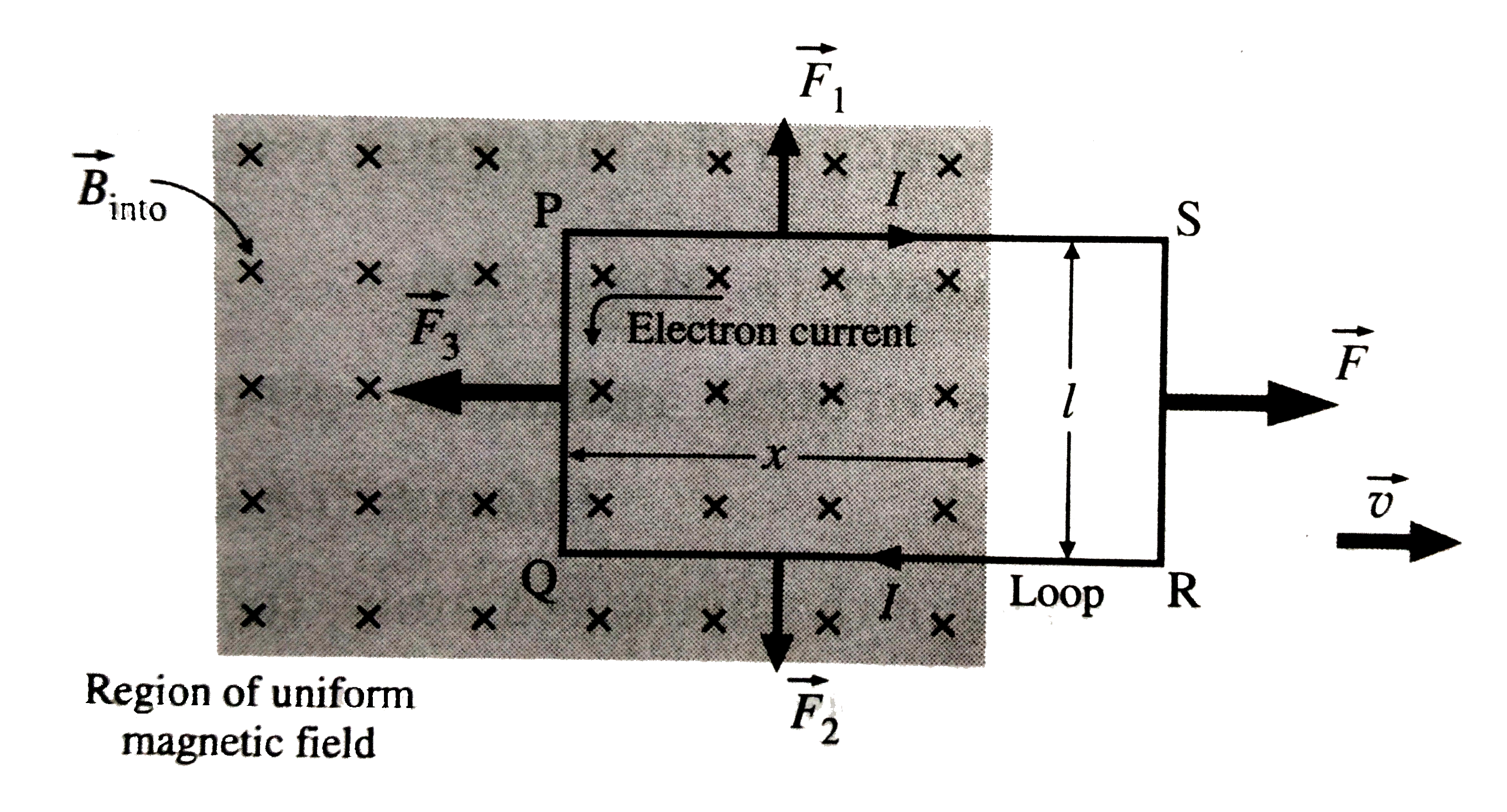 As the loop MOVES to the right through a distance dx = vdt in time dt, the area of the loop inside the field changes by `dA=ldx =lvdt. ` And, the changein the magnetic flux `dPhi` through the loop is `d Phi =Bda=Blvdt "" ` ...(2) Then, the time rate of change of magnetic flux is `(d Phi)/(dt)=(Blvdt)/(dt)=BLV "" ` ...(3) The changing magnetic flux induces a current `I` in the clockwise DIRECTION, as shown. a current-carrying conductor in a magnetic field experiences a force `vecF=I vecL XX vecB` (in the usual notation), whose direction can be found using Fleming'sleft hand rule. Accordingly, forces `vecF_(1) and vecF_(2)` on wires PS and QR, respectively, are equal in magnitude`(=IxB),` opposite in direction and have the same line of action. Hence, they balance each other. There is no force on wire RS as it lies outside the field. The force `vecF_(3)` on wire PQ has magnitude `F_(3)=IlB` and is directed towards the left. To move the loop with constant velocity `vec v`, an external force `vecF=-vecF_(3)` must be applied. The work done by the external agent is `dW=Fdx=-IlBdx=-IBdA=-Id Phi "" ` [from Eq. (2)] ...(4) Therefore, the power, i.e., the time rate of doing work, is `P=(dW)/(dt)=I(-(d Phi)/(dt)) "" ` ...(5) The electric power when an emf E drives a current through a circuit is given by `P=EI"" ` ...(6) In Eq. (4), P is the electric power when a current `I` is driven througha circuit as a consequence of a change in the magnetic flux through it. From Eqs. (5) and (6), `dW=Pdt =EIdt "" ` ...(7) Therefore, comparing Eq. (4) with Eq. (7),`E=-(dPhi)/(dt) "" ` ...(8) Thus, the emf induced in an electric circuit is equal to the negative of the time rate of change of the magnetic flux through the circuit, which is Faraday-Lenz's law. |
|