

Saved Bookmarks
| 1. |
Quinones are good electron acceptors, party because reduction restores aromaticity. Q+2e^(-)+2H^(o+)rarr H_(2)Q Give the decreasing order of E^(c-)._(reduction) of the following quinones : |
|
Answer» Solution :`a.` Decreasing order or `E^(c-)._(reduction):` `IIIgtIgtII` `b. IIIgtIIgtI""c.IIgtI` `a.` After reduction, products are `:` 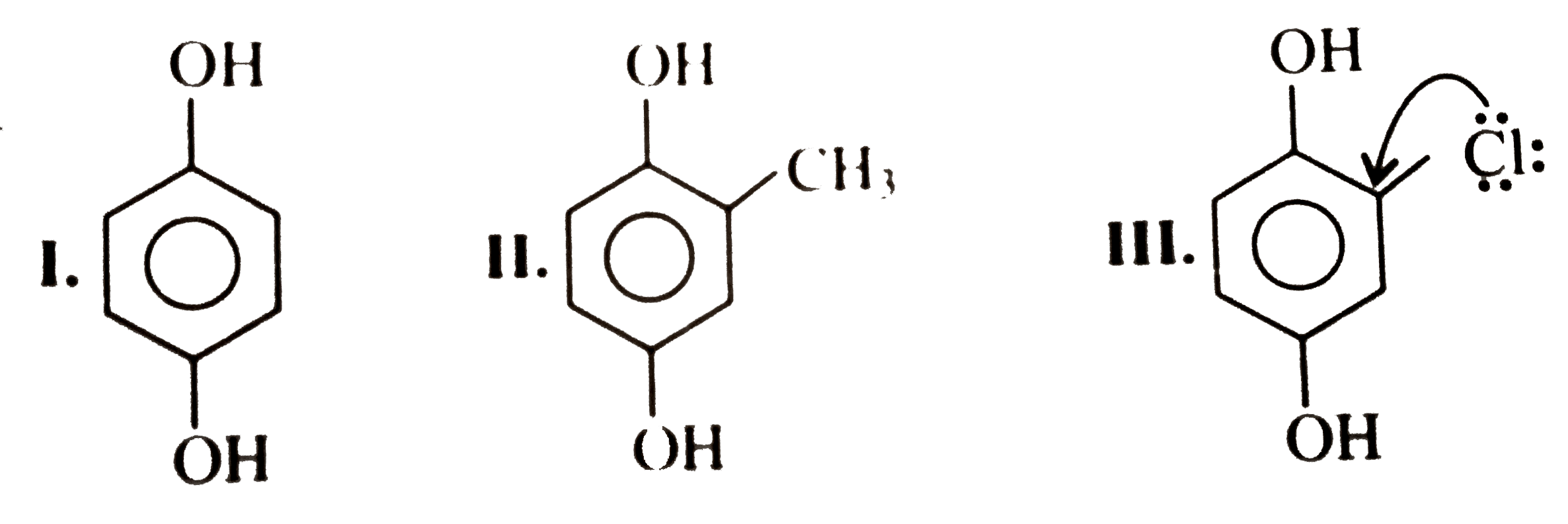 Reactivity order `: IIgtIgtIII` Stability order `: IIIgtIgtII` `III`is more stable due to `+R(` or `+M)` effect of `Cl` than `+I` and `H.C.` effect of `CH_(3)`. More stable the product means FASTER the reduction of quinone to hydroquinone and therefore higher `E^(c-)._(red)` value `:.` Decreasing order of `E^(c-)._(red)` value in `(a): IIIgtIgtII.` `b.` Stability order `: IgtIIgtIII` Reactivity order `: IIIgtIIgtI` `(III)` is more easily reducedt to  because it generates two aromatic rings which have more resonance energy and greater stability than the reaction of `(I)` and `(II)`, which would generate only one benzene ring. because it generates two aromatic rings which have more resonance energy and greater stability than the reaction of `(I)` and `(II)`, which would generate only one benzene ring. Both `(I)` and `(II)` on reduction GIVE one benzene ring, but `(II)` is less stable `(` more reactive `)` than `I` because adjacent `(C=O)` groups in `(II)` make it less stable .  The reaction is representes as follows `:` `Q+2H^(o+)+2e^(-) rarr H_(2)O` `:.` Reduction potential `(E^(c-)._(Q|H_(2)O)):IIgtI` . `c.` Stability order `: IgtII` Reactivity order `: IIgtI` Standard reduction potential `(E^(c-)._(Q|H_(2)O)):IIgtI` 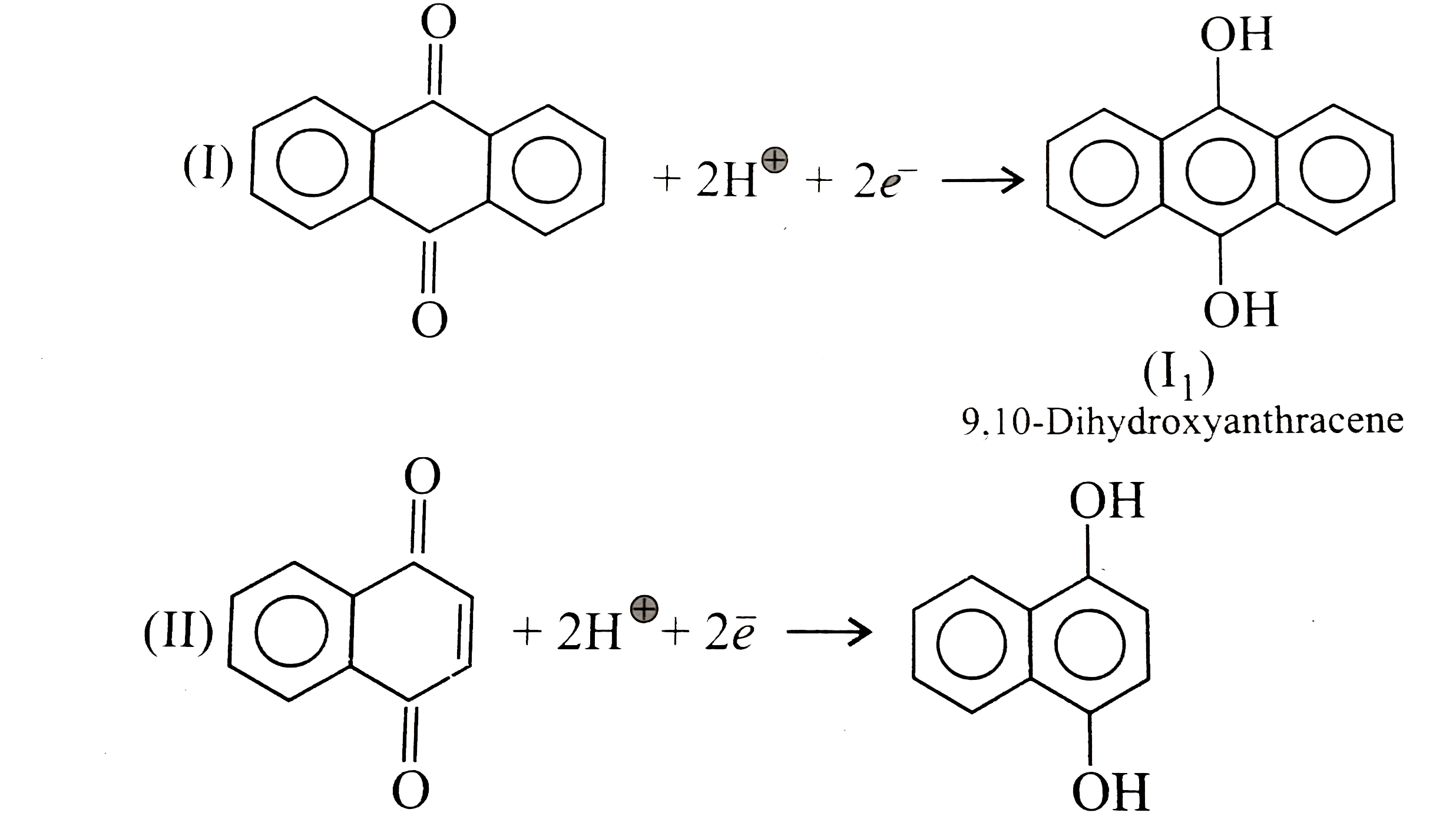 `(I)` has two individual benzene rings whose combined resonance energy along with that ot two `(C=O)` groups is more than the resonance energy of three benzene rings of reduced product `(I_(1))`. |
|