Saved Bookmarks
| 1. |
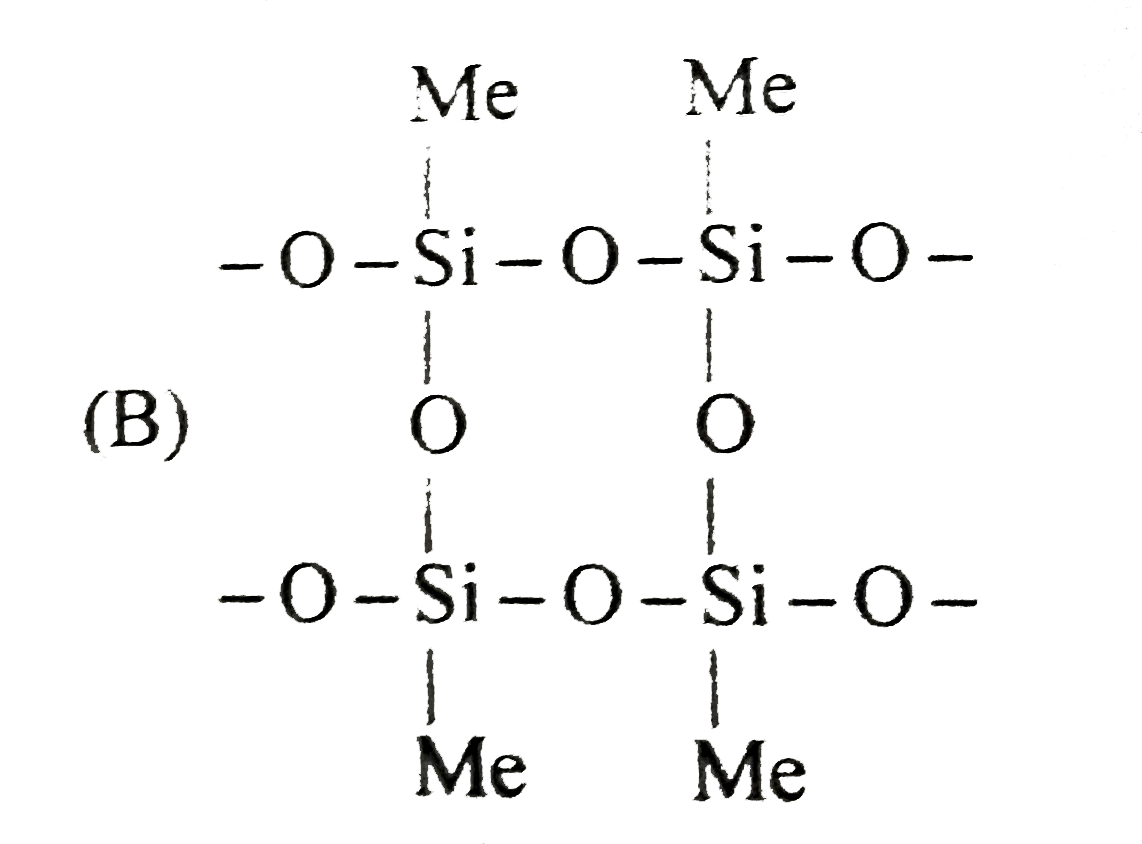
Read the following write-ups and answer the questions at the end of it. Silicons are synthetic polymers containing repeated R_(2)SiO unit. Since, the imperical formula of a ketone (R_(2)CO), the name silicone has been given to this materials. silicons can be made into oils, rubberly elastamors and resins. They find a variety of applications because of their chemical inertness,water repelling nature, heat-resistence and good electrical insulating property. Commercial silicone polymers are usally methyl derivatives and to lesser a extent phenyl derivatives and are synthesised by the hydrolysis of R_(2)SiCl_(2) [R =methyl (Me) or phenyl (phi)] Me_(2)SiCl_(2) overset(H_(2)O)to O-overset(Me)overset(|)underset(Me)underset(|)(Si)-O-overset(Me)overset(|)underset(Me)underset(|)(Si)-O-overset(Me)overset(|)underset(Me)underset(|)(Si)-O- If we start with MeSiCl_(3) as the starting material, silicons formed is : |
|
Answer» `Me-overset(Me)overset(|)underset(Me)underset(|)(SI)-O-overset(Me)overset(|)underset(Me)underset(|)(Si)-O-overset(Me)overset(|)underset(Me)underset(|)(Si)-O-overset(Me)overset(|)underset(Me)underset(|)(Si)-Me` |
|