

Saved Bookmarks
| 1. |
Refer to figure the arm PQ of the rectangular conductor is moved from x = 0, outwards. The uniform magnetic field is perpendicular to the plane and extends from x = 0 to x = b and is zero for x gt b. Only the arm PQ possesses substantial resistance r. Consider the situation when the arm PQ is pulled outwards from x = 0 to x = 2b and is then moved back to x = 0 with constant speed v. Obtain expressions for the flux, the induced emf, the force necessary to pull the arm and the power dissipated as Joule heat. Sketch the variation of these quantities with distance. |
Answer» Solution :Part I: When slider arm PQ moves towards right from x = 0 to x = b and then from x = b to x = 2b with constant speed v, 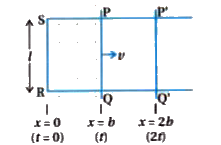 Here POINTS R and S are fixed points whereas points P and Q keep on sliding from S to P. and from R to Q. as slider arm changes its position from x = 0 to x = 2b. Required quantities can be found out as follows: (i)Magnetic flux : `phi`=Blx (From x =0 to x=b) `phi`=Blb (From x =b to x = 2b) Here, from x=0 to x=b , `phi` increases linearly with x whereas from x=b to x=2b, `phi` remains constant ) ...(1) (ii)induced emf : From x=0 to x=b, `phi=Blx=Bl(vt)` `therefore epsilon=-(dphi)/(dt)`=-Blv(1)=-Bvl =constant From x=b to x=2b, `epsilon=0` (`because phi`=constant)...(2) (iii)External FORCE to keep slider arm PQ under equilibrium : `F = I l B sin 90^@ =IlB=epsilon/r lB` `therefore F=((-Bvl))/r lB=-(B^2l^2v)/r` (Where r= resistance of slider arm PQ) ...(3) `therefore` F=constant (`because` B,l,v,r are CONSTANTS) From x=0 to x=b , `F=-(B^2l^2v)/r` = constant From x=b to x=2b, `F=-(B^2l^2v)/(vr)=epsilon^2/(vr)=0 (because epsilon=0)`...(4) (iv) Joulean power , `P=epsilon^2/r=(B^2v^2l^2)/r` From x=0 to x=b , `P=(B^2v^2l^2)/r=epsilon^2/r`=constant From x=b to x=2b, P=0 (`because epsilon=0`) ...(5) From results (1),(2),(3),(4) and (5) graphs of `phi,epsilon,F,P to x` can be plotted as follows : 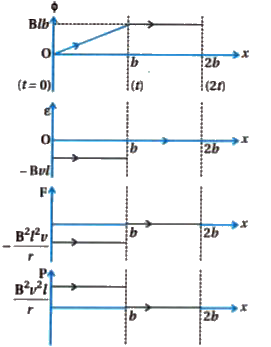 Part II : When slider arm moves towards left from x = 2b to x = b and then from x = b to x = 0 with constant speed v. In this case, all of above graphs are retraced in the directions opposite to previous graphs as shown below. 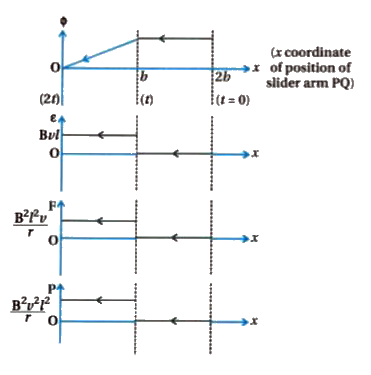
|
|