

Saved Bookmarks
| 1. |
Referring to figure calculate the downward acceleration of mass m_1. Assume the surfaces are frictionless and pullyes are massless. |
|
Answer» Solution :LET a be the acceleration of mass M and `a_1 and a_2`, the acceleration of `M_1 and M_2` relative to fixed pulley, P. Then from shown in figure. `M_1 g - T_2 = M_1 a_2` ........... (1) `M_2 g -T_2 = M_2a_2` ......... (2) `and T_1 = Ma ` Also `T_1 = 2T_2` ........ (4) Acceleration of `M_1` relative to MOVABLE pulley Q is `(a_1- a)` . Acceleration of `M_2` relative to pulley `Q=(a_2 -a)`. The acceleration of `M_1 and M_2` relative to puelly Q are equal and opposite . ` :. a_1 - a = -(a_2-a)` ` or a =(a_1 + a_2)/( 2)` .......... (5) substracting (2) from (1) `(M_1 - M_2) g = M_1 a_1 - M_2 a_2` ......... (6) Adding (1) and (2) , we get `(M_1 + M_2) g - 2T_2 = M_1 a_1 + M_2a_2` From (3) and (4) , ` 2T_2 = T_1 =Ma ` Using `(5) , 2T_2 =(M(a_1 + a_2))/(2)`............ (7) SUBSTITUTING this value in (7) , we get `(M_1 + M_2) g -(M(a_1+ a_2))/(2) = M_1 a_1 + M_2 a_2` ` or 2(M_1 + M_2) g - Ma_1 - Ma_2 = 2M_1 a_1 + 2M_2a_2` ` or 2(M_1 + M_2)g = (2 M_1 + M)a + (2M_2 + M)a_2` .......... (8) ELIMINATING ` a_2 ` from (6) and (8) , we get ` a_1 = [(4M_1 M_2 + M(M_1 -M_2))/(4M_1M_2+ M(M_1 + M_2))]g` 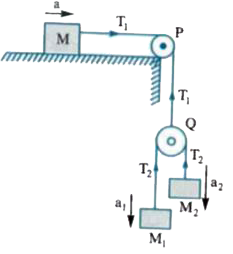
|
|