

Saved Bookmarks
| 1. |
Refraction of ray incident on a boundary of another plane A ray given by -hati-2hatj is incident on xz plane as shown in Fig. 34-4. Above the xz plane, refractive index is n_(1)=2 and below the xz plane refractive index is n_(2)=sqrt(5//2). Find a unit vector in the direction of the refracted ray. |
|
Answer» Solution :(1) Note that although the incident ray is drawn in the first quadrant, its direction is in the third quadrant. This is because the direction of a vector is given by the direction in which its arrow points. To represent this vector in a vector form, we have to redraw it in such a way that its tail is at the origin. Note that refraction deviates a ray from its path, it does not changes the quadrant. For the complete direction of the refracted ray, we can use Snell.s law. (2) First , we canvert the incident ray vector into a unit vector by dividing it by its magnitude. Then we can apply Snell.s law. As seen from FIG. 34-4, we can say that the tangential component of the incident ray is 1 sin THETA because the magnitude of the incident ray vector has been MADE unity. Similarly, the tangential component of the refracted ray is given by `1sinphi`. By Snell.s law, `n_(1)sintheta=n_(2)sinphi` So, we can say that `n_(1)xx` tangential component of incident ray `=n_(2)xx` tangential component of refracted ray. Once we get the tangential component of the refracted ray, we get the normal component by using the fact that the refracted ray is ALSO a unit vector. So , its magnitude is 1. 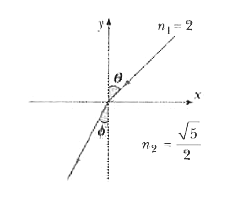 A ray travelling in x-y plane is incident on a boundary which separates the two media. The boundary of the media is `x-z` plane. Calculation : Converting the incident ray vector to a unit vector : `hatei=((-hati-2hatj))/(sqrt((-1)^(2))+(-2)^(2))=-(hati)/(sqrt(5))-(2)/(sqrt(5))hatj`. From Fig. 34-4, it can be seen that the normal is in the y direction. The component of this vector in the tangential direction (x direction in this case) is `-hati//sqrt(5)`. So, by Snell.s law, we can say that `-(hati)/(sqrt(5))xx2=(sqrt(5))/(2)xx` tangential component of refracted ray. Tangential component of refracted ray `=-(4i)/(5)` Let the normal component of the refracted ray be `-chatj`. (The refracted ray should also travel in the third quadrant). Threfore, `hate_(r )=-(4hati)/(5)-chatj` So, `1=sqrt(((-4)/(5))^(2)+(-c)^(2))` `c=(3)/(5)`. Therefore, `hate_(r )=-(4)/(5)hati-(3)/(5)hatj` Learn : In more involved problems , we can also involve the fact that incident ray, refracted ray, and normal all three lie in the same plane. Hence, their scalar triple product is ZERO. If one finds it encourging , then one must try this our : `hate(hate_(r )xxhatn)=0` |
|