

Saved Bookmarks
| 1. |
Refraction through eye of Anableps anabelps fish Figure 34-28 shows a vertical cross section through an eye of the Anableps anableps fish that swims with each eye half in and half out of the water, with a pigment band separating the two halves at the water surface. The front of the eye (the cornea) is a spherically convex refracting surface of radius r=1.95mm and index of refraction n_(2)=1.335. The refraction at the cornea is the first step in the eye's focusing of a real image into the back of the eye (the retina), where visual processing begins. If the cornea faces an insect (lunch) at object distance p=0.20m, what is the image distance i of that refraction for the cornea in air (n_(1)=1.000) and in water (n_(1)=1.333) ? |
|
Answer» Solution :(1) Because the object and its image are on opposite SIDES of the refracting surface with its convex side facing the object, the situation is like either Fig. 34-24a (for a real image) or Fig.34-24c (for a virtual image). (2) Image distance and object distance are related by `(n_(1))/(p)+(n_(1))/(i)=(n_(2)-n_(1))/(r )` Calculation : SOLVING this equation for i gives us `i=(n_(2))/((n_(2)-n_(1))/(r )-(n_(1))/(p))` Substituting the given values and using the index of refraction `n_(1)=1.000` for air, we find `i=(1.335)/((1.335-1.000)/(0.00195)-(1.000)/(0.20))` `=8.00mm` Repeating the calculation but using the index of refraction `n_(1)=1.333` for water, we find `i=(1.335)/((1.335-1.333)/(0.00195)-(1.333)/(0.20))` `=-0.237m` Learn : After LIGHT is refracted by the cornera, it is further refracted by a lens to give a final real image on the retina. (The function of a lens is discussed in the next section). Our first answer is positive (indicating a real image, as needed) and about twice the diameter of the eye. Thus, the role of the lens in focusing the light onto the retina is moderate because so much refraction occursat the cornea. Our second answer is quite DIFFERENT : It is negative (indicating a virtual image ) and much larger. So far more focusing is required by the lens to put a real image onto the retina. to provide moderate focusing of light from the water, the eye lens in Anableps anableps is egg shaped, with much greater curvature in the bottom half than in the top. 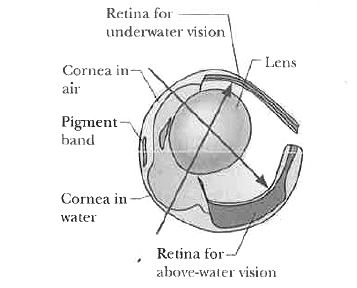
|
|